
What Are The Core Components of a Fingerprint Scanner
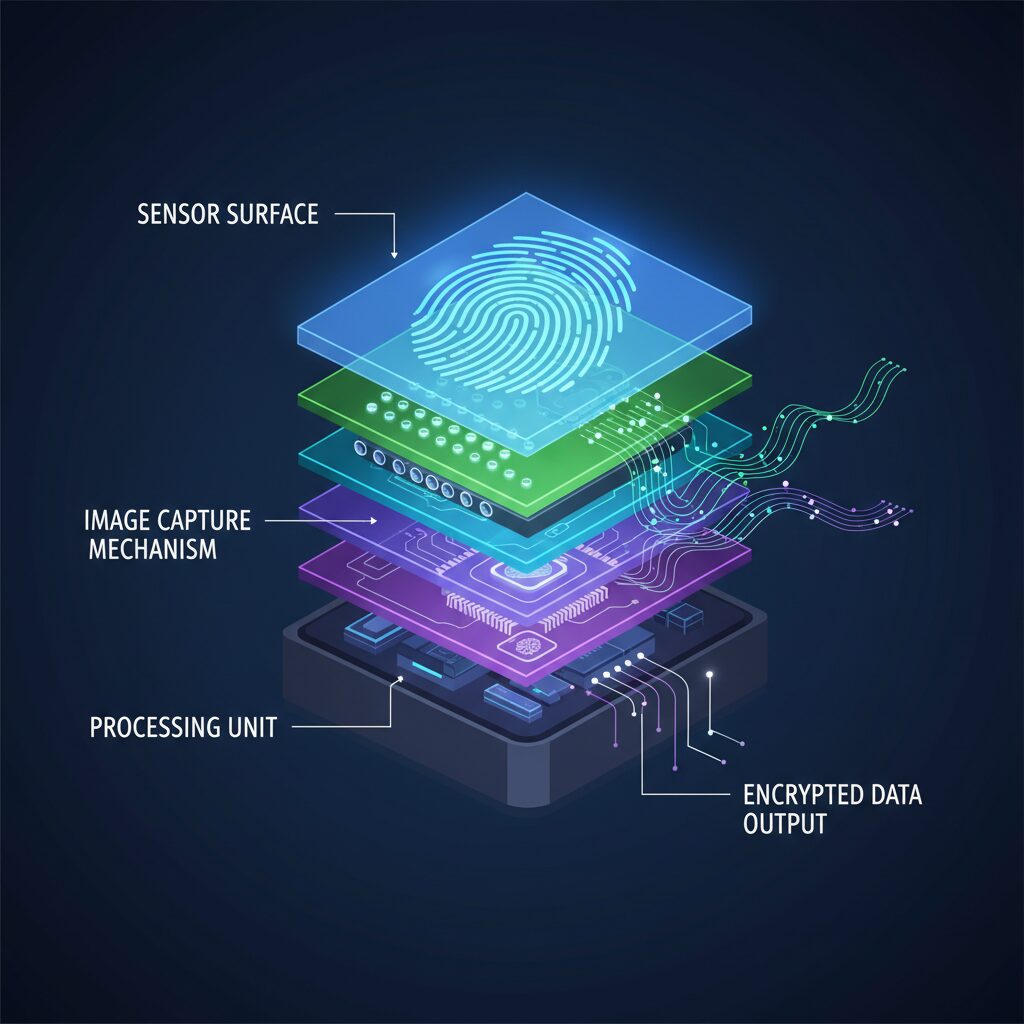
At its core, a fingerprint scanner for business security is a sophisticated system designed to capture, process, and verify the unique ridge and valley patterns on an individual’s finger. These devices are complex systems comprising several key components that function in unison:
- Sensor Surface: This component serves as the direct user interface. Constructed from durable, scratch-resistant materials, the sensor surface is engineered for reliability in high-traffic environments, such as retail point-of-sale (POS) terminals or corporate access points. The integration of internationally certified films can further enhance durability and performance.
- Image Capture Mechanism: As the central component, the capture mechanism is responsible for converting the physical topography of a fingerprint into a digital image. The specific methodology employed here is the primary differentiator between scanner types, such as optical and capacitive technologies.
- Analog-to-Digital Converter (ADC): After the image capture mechanism generates an analog signal of the fingerprint, the ADC converts this signal into a digital format suitable for computational processing.
- Processing Unit and Encryption: This unit executes several critical functions on the digitized fingerprint data. It enhances the image quality, extracts unique features known as “minutiae points” (e.g., ridge endings and bifurcations), and converts these features into a secure mathematical template. The raw fingerprint image is typically destroyed post-conversion to ensure user privacy. This template is then securely stored—either on-device or within a protected database—for subsequent authentication. Advanced processing units also integrate sophisticated anti-spoofing (PAD) technologies to detect and reject fraudulent fingerprint attempts.
- Interface: Seamless integration is a critical requirement for business applications. A fingerprint scanner utilises standard interfaces like USB or serves as an embedded module for integration into larger platforms. If you are looking to build a broader security network around these scanners, you specifically need to look at Access Control Systems: The Definitive Guide (2026 Update).
Organizations select hardware based on strategic factors such as processing speed (e.g., sub-one-second matching to maintain operational efficiency), durability for high-use areas, and compatibility with existing single sign-on (SSO) or multi-factor authentication (MFA) frameworks. Within sectors like finance, retail, and healthcare, fingerprint scanners perform essential functions, from mitigating fraud at ATMs to enabling POPIA-compliant patient identification. This reliability is exactly why the fingerprint reader has evolved beyond simple access control. For a comprehensive look at how this hardware is reshaping workforce management, read our guide on the Biometric Clocking System: The Future of Time and Attendance Systems.
Optical vs. Capacitive Fingerprint Readers: What Is the Difference?
While numerous technologies exist, optical and capacitive scanners are the most prevalent in business security applications. Understanding their distinctions is crucial for selecting the appropriate solution for specific organizational needs.
Optical Scanners
An optical fingerprint reader functions using a principle analogous to a digital camera.
- Capture Method: They utilize a high-intensity LED light to illuminate the finger placed on a prism. A camera or charge-coupled device (CCD) then captures the reflected light. The unique patterns of ridges and valleys on the finger create variations in light reflection, generating a high-contrast digital image of the fingerprint through a process known as frustrated total internal reflection.
- Advantages:
- Economical: Generally less expensive to manufacture, making them suitable for organizations with budgetary constraints.
- Surface Condition Tolerance: Can often read fingerprints even with minor surface contaminants or moisture.
- Durability: The sensor surface can be engineered to be highly robust.
- Limitations:
- Reduced Image Fidelity: Typically offer lower image resolution compared to capacitive scanners.
- Susceptibility to Interference: Excessive smudges on the sensor or high ambient light can degrade image capture quality.
- Larger Form Factor: Often require more physical space due to their optical components.
- Vulnerability to Spoofing: Historically, optical scanners have been more susceptible to spoofing via high-quality fake fingerprints, although modern iterations include advanced anti-spoofing countermeasures.
- Business Applications: Optical scanners are frequently deployed in cost-sensitive retail or POS environments where budget is a primary consideration. They represent a viable solution for businesses looking to modernize physical security without a significant capital investment.
Capacitive Scanners
Capacitive fingerprint scanners employ a more sophisticated methodology, leveraging electrical capacitance to map the fingerprint.
- Capture Method: Instead of light, these scanners use an array of micro-capacitors embedded in the sensor surface. When a finger is placed on the scanner, the conductive ridges make contact with the capacitors, altering their electrical charge. The non-conductive valleys (air gaps) produce a measurably different charge. The scanner’s processor analyzes these electrical variations across the array to construct a highly detailed map of the fingerprint’s topography.
- Advantages:
- Superior Image Fidelity and Precision: Provide a much more detailed and accurate image of the fingerprint, capturing fine minutiae.
- Compact Form Factor: Can be manufactured in very small sizes, making them ideal for integration into laptops, USB authenticators, and compact access control readers like standard USB models for Windows Hello.
- Rapid Authentication: Generally offer faster authentication speeds.
- Enhanced Anti-Spoofing Capabilities: Significantly more difficult to spoof than basic optical scanners because they detect the electrical properties of living tissue, not just a surface pattern.
- Limitations:
- Higher Production Cost: Typically more expensive to manufacture.
- Sensitivity to Skin Conditions: Performance can be affected by excessively dry or moist skin, which can alter conductivity.
- Compact Capture Surface: May feature a smaller active scanning area.
- Business Applications: Capacitive scanners are the optimal solution for corporate environments, financial institutions, and any application where high-security multi-factor authentication is critical. Their reliability, accuracy, and robust anti-spoofing defenses make them ideal for securing sensitive logins, protecting critical data, and preventing fraud. Many models are internationally certified and engineered to be highly resistant to scratches and water.
Selecting the Optimal Fingerprint Scanner for Your Organization
That’s a wrap on our technical deep dive into fingerprint scanner architecture.
As we’ve seen, the choice between optical and capacitive technology isn’t just about preference—it’s about matching the internal hardware to your specific security environment.
Whether you prioritize the cost-efficiency of an optical device or the anti-spoofing precision of a capacitive fingerprint reader, understanding the engineering under the hood ensures you aren’t just buying a gadget, but investing in a robust security asset.