

The Role of SASSA
SASSA is the government agency mandated to administer and distribute social grants to vulnerable South African citizens. Its primary function is to provide a social safety net and alleviate poverty, not to directly finance education.
These grants deliver essential income support to individuals unable to support themselves, including:
- Children (Child Support Grant)
- The elderly (Old Age Grant)
- Persons with disabilities (Disability Grant)
- Families providing care for children (Foster Child Grant, Care Dependency Grant)
While these grants offer critical financial relief, they are not structured as educational bursaries.

How NSFAS Funds Higher Education in South Africa
The National Student Financial Aid Scheme (NSFAS) is the South African government’s dedicated entity for financing higher education. While many applicants mistakenly search for a sassa bursary, NSFAS is the actual provider of the government student loans South Africa relies on to support low-income and working-class households. Its mandate is to provide financial aid to students who intend to study at public universities or Technical and Vocational Education and Training (TVET) colleges.
NSFAS provides comprehensive funding through bursaries and, more recently, loans to cover essential costs, including:
- Tuition fees
- Registration fees
- Accommodation
- Allowances for living expenses, learning materials, and transport
To qualify for an NSFAS bursary, the applicant’s combined annual household income must not exceed R350,000.
Can You Receive Both SASSA and NSFAS Funding?
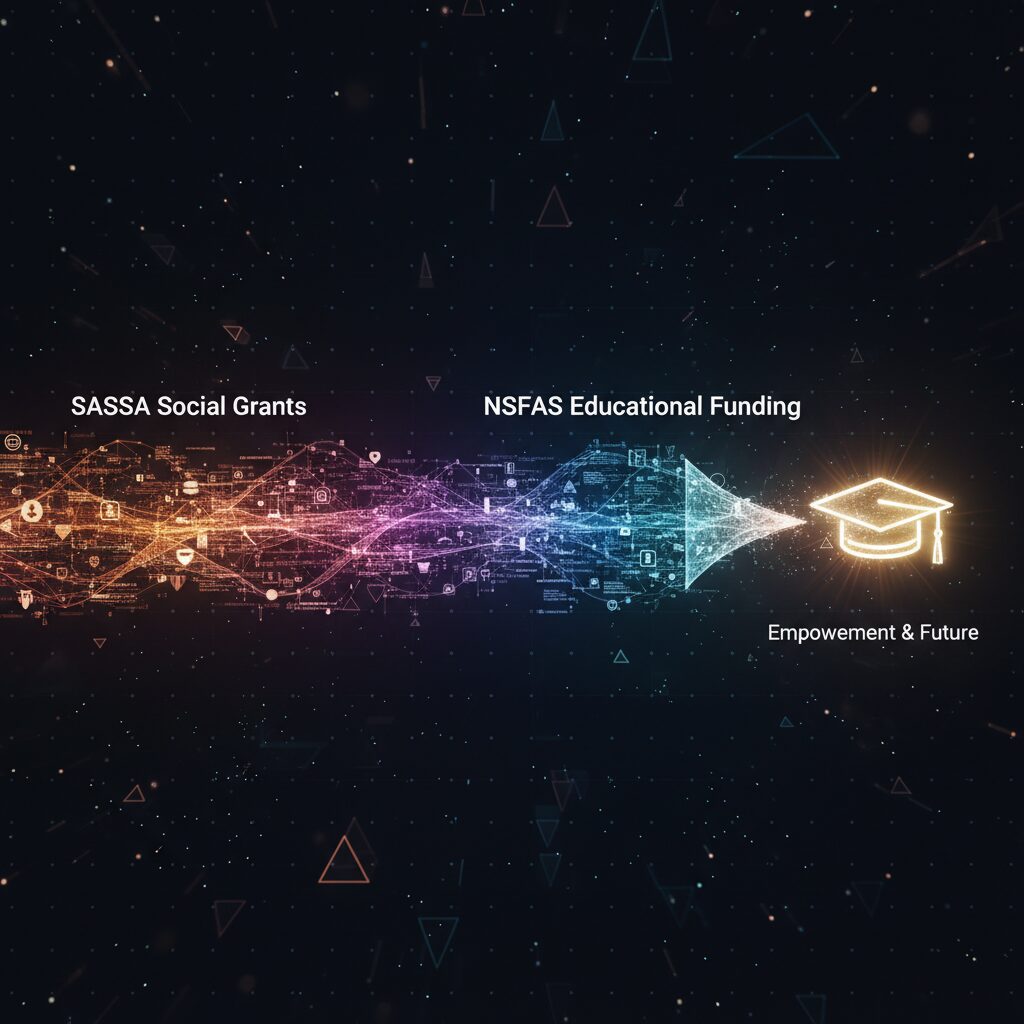
The intersection of these two systems is a critical point of inquiry for many applicants. A student can, in many circumstances, be a beneficiary of both SASSA and NSFAS. This unique crossover is often what people refer to when they discuss the concept of a sassa bursary.
Automatic Qualification for SASSA Beneficiaries
The government recognizes that individuals receiving specific long-term social grants have already met a financial means test. To streamline the application workflow and reduce the administrative burden, students who are current SASSA grant recipients are automatically approved for NSFAS funding, contingent upon their acceptance into a qualifying course at a public institution.
According to an official NSFAS statement, this immediate funding decision applies to applicants receiving:
- Child Support Grant
- Foster Child Grant
- Care Dependency Grant
- Disability Grant
This integrated system ensures that the most vulnerable students have a direct and secure pathway to accessing educational funding.
The Exception: The SRD (R370) Grant
A notable exception is the Social Relief of Distress (SRD) Grant, also known as the R370 grant. Receiving the SRD Grant does NOT result in automatic qualification for NSFAS. The SRD grant is designed as a temporary, short-term intervention for individuals in immediate financial distress, whereas NSFAS is structured for long-term educational commitment. Therefore, SRD recipients must apply for NSFAS through the standard process and meet all requisite income and academic criteria.
Key Differences: SASSA vs. NSFAS Explained
| Criterion | SASSA | NSFAS |
|---|---|---|
| Primary Mandate | Administer social welfare and alleviate poverty | Finance higher education for eligible students |
| Target Group | Vulnerable populations (children, elderly, disabled) | Financially qualifying students at universities & TVETs |
| Provision | Monthly cash payments (grants) | Funds for tuition, accommodation, and allowances |
| Income Threshold | Varies by grant type | ≤R350,000/year (bursary); R350k-R600k/year (loan) |
| Key Requirement | Demonstrated vulnerability / inability to work | Acceptance into a qualifying course & academic progress |
How the Systems Integrate
The automatic qualification pathway for SASSA beneficiaries is a significant operational advantage. It validates their financial need without requiring the extensive submission of income verification documents necessary for other applicants. This streamlined process is a substantial benefit, though it remains essential for all applicants to understand the full spectrum of available funding options.
To ensure you don’t miss any critical deadlines or requirements, read our comprehensive breakdown on how to apply for a bursary, which serves as your definitive guide to NSFAS & financial aid.
This integration allows NSFAS to strategically allocate a significant portion of its budget—nearly half in 2023—directly to students from SASSA-supported households, creating an effective bridge from social support to educational opportunity.
Important Considerations for All Applicants
Securing your future through a sassa bursary or government student loans South Africa offers is a life-changing opportunity, but getting the funding is only the first half of the journey. To keep your financial aid active, you have to stay on top of your game.
Regardless of whether qualification is automatic via SASSA or through a standard application, all students receiving NSFAS funding must adhere to academic performance requirements to maintain eligibility. As detailed by institutions like Stellenbosch University, students are required to pass their modules and progress through their qualification within a specified timeframe (the “N+ rule”). Failure to meet these academic benchmarks can result in the termination of funding.
By understanding the distinct functions and integrated nature of these two vital government programs, applicants can more effectively navigate the process of securing the financial support required for their academic and professional futures.