

What is an Inventory Management System?
At its core, an inventory management system takes the guesswork out of manual counting by automating your most time-consuming tasks. Instead of relying on handwritten notes or rough estimates, an IMS provides one digital “source of truth” where all your stock data lives. It acts as the central brain of your business, linking your warehouse, shop floor, and checkout into one perfectly synced platform.
This technology extends far beyond simple inventory counts. A modern stock management system empowers your organization to:
- Maintain real-time inventory visibility: Gain precise, 24/7 knowledge of stock levels and locations across all facilities.
- Automate procurement: Implement reorder points to automatically generate purchase orders, preventing stockouts of high-demand items.
- Analyse sales performance: Identify top-performing products and isolate slow-moving inventory for strategic decision-making.
- Mitigate human error: Eliminate costly inaccuracies associated with manual data entry and reconciliation.
- Streamline supplier management: Maintain a detailed record of supplier lead times, costs, and procurement histories.
The Foundational Components of a Modern Inventory System
A comprehensive inventory management system is structured around three essential, interdependent components.
Software
The software is the core intelligence of the system, acting as a centralized database that records all inventory transactions. For smaller South African businesses, this functionality may be an integrated feature of their Point of Sale (POS) solution. For larger corporations, it is often a powerful, standalone cloud-based platform. Key software capabilities include real-time stock level monitoring, sales analytics, and demand forecasting.
Hardware
Hardware components are the physical tools that facilitate data capture and transmission to the software platform. They serve as the interface between physical assets and digital records. Standard hardware includes:
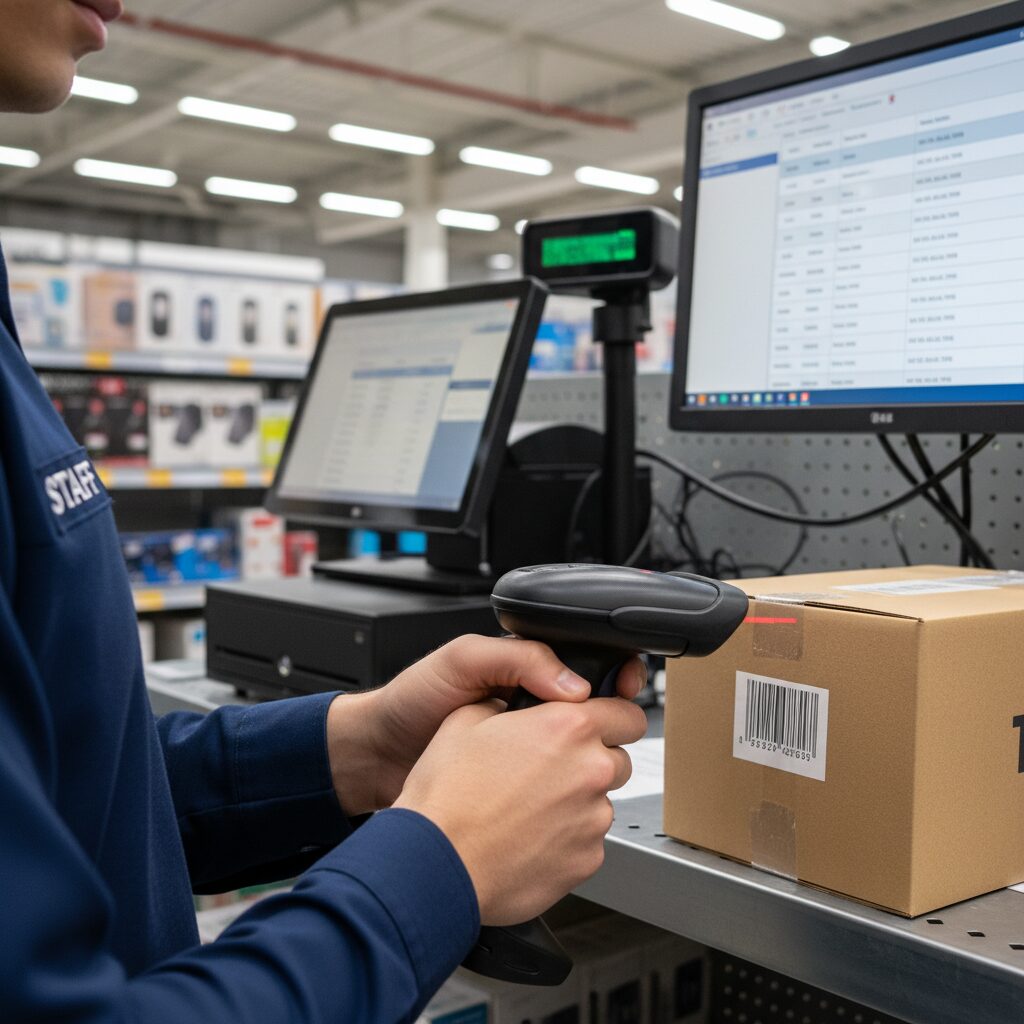
- Barcode Scanners: To enable rapid and accurate product identification during receiving, inventory audits, and at the point of sale.
- POS Terminals: The transactional endpoint where sales are processed, which automatically decrements sold items from the inventory database.
- Mobile Devices: Smartphones or dedicated tablets can be leveraged for mobile inventory audits and management.
Processes
Technology alone is not enough to get the job done. The success of the system depends entirely on the daily habits and clear rules that support it. This means having a set way of doing things—like checking in new stock correctly, performing regular “spot-checks” to ensure your records are accurate, and following a clear process for handling customer returns.
How an Inventory Management System Tracks Stock: The Complete Lifecycle
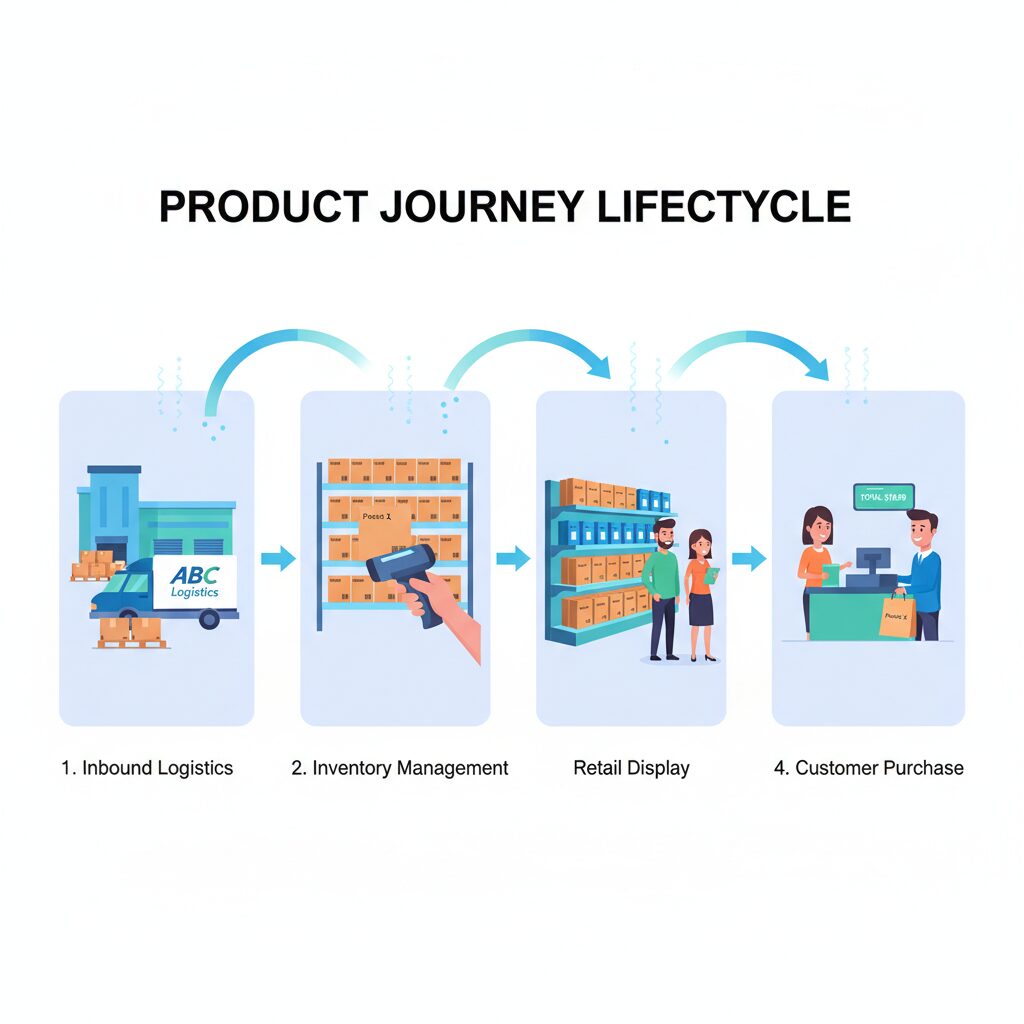
To fully appreciate the operational power of an IMS, it is instructive to follow a product through its entire lifecycle within the business.
1. Goods Receiving
The inventory lifecycle begins with procurement and receiving. When a supplier delivery arrives, personnel use a barcode scanner to log each item. The inventory management system validates the delivery against the corresponding purchase order, and upon confirmation, the software database is updated automatically, reflecting the new products as available for sale.
2. In-Store and Warehouse Tracking
Each product is assigned a unique Stock Keeping Unit (SKU) for precise identification. The IMS utilizes this SKU to track the item’s exact location, whether in a central storeroom, on a specific warehouse shelf, or on the retail floor. This granular tracking eliminates time spent searching for products and provides a clear, strategic overview of all stock distribution.
3. Point of Sale (POS) Integration
This is a critical point of integration for retail operations. When a customer purchases a product, the item’s barcode is scanned at the POS terminal. The integrated system immediately deducts that unit from the total inventory count in real-time. This function is crucial for maintaining perpetual inventory accuracy. As noted by Salesforce, this level of integration is fundamental for modern retail efficiency.
4. Reordering and Replenishment
An intelligent IMS proactively prevents stockouts. Minimum stock levels, or “reorder points,” can be configured for each product. When the real-time count reaches this threshold, the system can trigger an automated alert or generate a draft purchase order for supplier submission. This ensures consistent availability of best-selling items.
5. Reporting and Analytics
Beyond tracking, an IMS is a powerful business intelligence tool. It generates detailed reports that reveal product profit margins, identify slow-moving stock, and illustrate changes in inventory valuation over time. This data is invaluable for making informed purchasing decisions and optimising your product portfolio for maximum profitability. For smaller operations looking to harness these insights without a heavy initial investment, exploring Free Inventory Management Software: 5 Proven Tools for Small Businesses (2026) can provide a cost-effective entry point into automated tracking.
Case Study: Shoprite’s Approach to Large-Scale Inventory Management
While the specific architecture of Shoprite’s proprietary system is confidential, we can analyze how a retail leader with over 2,900 stores applies inventory management principles to operate at immense scale.
Centralised Control for a Nationwide Footprint
To manage its vast network of stores across Southern Africa, Shoprite utilises a highly sophisticated, centralised IMS. This platform provides head office with a real-time, consolidated view of every product across all stores and distribution centres. This enables strategic inventory allocation, such as transferring stock between locations to align with regional demand, thereby maximising sales efficiency.
Demand Forecasting and Supply Chain Integration
Shoprite’s stock management system is engineered to manage immense volume and product diversity, from perishable goods to long-shelf-life staples. As IBM outlines, inventory management involves tracking stock from manufacturers to warehouses and to the point of sale. For Shoprite, this means the system must analyze vast sets of historical sales data to forecast demand, factoring in variables like seasonality and promotional events. This data-driven forecasting automates ordering from a complex supplier network, ensuring product availability.
Technology at the Point of Sale
Every transaction at a Shoprite checkout terminal instantly feeds data back into the central system. This action updates national inventory levels, contributes to forecasting models, and triggers store-specific replenishment alerts. This seamless, real-time flow of information is what enables the management of millions of products and daily transactions with exceptional accuracy.
A More Reliable Way to Manage Your Operations
As a retail business grows, the manual methods that once felt manageable quickly become a bottleneck for profit. When you reach the stage where you need to handle real-time updates across multiple staff members or maintain accuracy during power disruptions, your processes need to evolve alongside your goals.
This is where Eezipay helps. Our Touch POS and retail tools serve as the “central hub” described in this guide, ensuring your warehouse and shop floor stay perfectly in sync. It is a practical way to replace the stress of manual record-keeping with a system designed for the realities of South African retail. If you would like more insight into how these tools function in a live environment, you can explore the Eezipay Touch POS and management features here.
Selecting the Appropriate Inventory System for Your SA Business
The benefits of an IMS are not exclusive to large corporations. The objective is to select a system that aligns with the scale and complexity of your business operations.
For Emerging Enterprises
For new ventures, the integrated inventory features within a POS system are an excellent starting point. Providers prevalent in South Africa offer built-in tracking suitable for managing a limited product catalogue. This approach establishes disciplined inventory practices from the outset and avoids a reliance on manual spreadsheets.
For Expanding and Multi-Location Operations
As a business expands to multiple locations or launches an e-commerce platform, a more robust, dedicated system is required. Prioritise cloud-based inventory management software that delivers:
- Multi-location management: The capability to monitor and manage inventory across all branches and warehouses from a single, unified dashboard.
- E-commerce integration: The ability to automatically synchronise stock levels between physical stores and online sales channels (e.g., Shopify or WooCommerce).
- Advanced reporting: Access to deeper analytics on profitability, stock turnover rates, and supplier performance metrics.
Key Vendor Evaluation Questions
When assessing potential systems, pose these questions to vendors within the South African context:
- Does your software integrate with our current POS and financial systems?
- What is the total cost of ownership in ZAR, including implementation, licensing, and support fees?
- Do you provide dedicated, local customer support during South African business hours?
- What is the system’s operational protocol during power disruptions like load-shedding? Does it feature an offline mode with subsequent data synchronisation?
Achieving Inventory Control and Operational Excellence
In the competitive South African retail sector, efficient inventory management is not an advantage—it is a prerequisite for survival and growth. By transitioning from manual processes to a dedicated system, you mitigate financial risk, reduce operational costs, and gain the data-driven insights necessary for strategic decision-making. An inventory management system empowers you to take full control, transforming your stock from a logistical challenge into your most valuable operational asset.