
Running an on-site staff shop or canteen is a fantastic employee benefit, but managing the associated automated salary deductions can quickly turn into a compliance nightmare. If you are tired of losing hours to tedious spreadsheet reconciliations and worrying about legal risks, we have a complete game-changer for your business. In this comprehensive guide, we reveal exactly how a modern closed-loop system handles the heavy lifting, effortlessly protects your business from costly audit failures, and completely eliminates your monthly administrative burden.
Dive in to discover how easy workplace commerce compliance can be.
The Inefficiencies and Risks of Manual Management
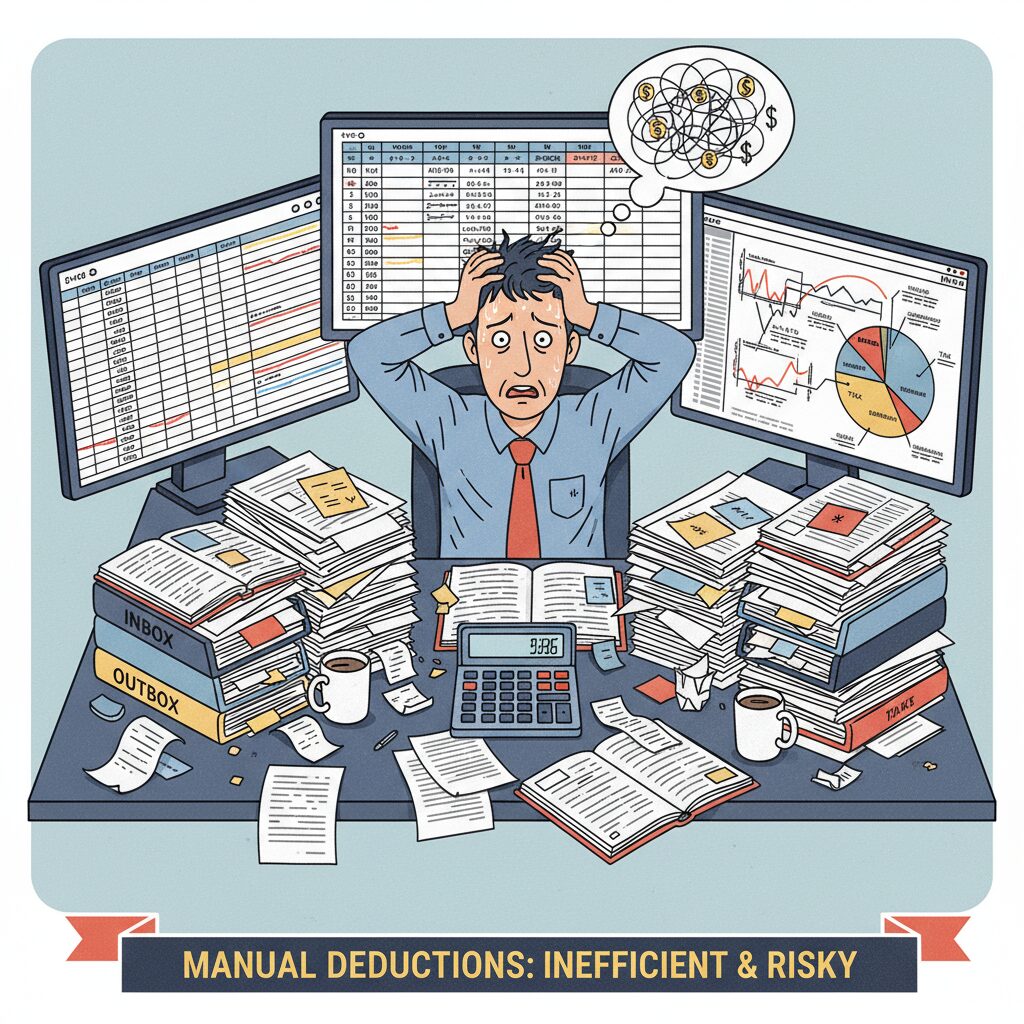
For many organisations, the month-end reconciliation for staff shop deductions is a labour-intensive process. It typically requires a payroll manager to process a spreadsheet from the canteen, containing employee numbers and total amounts owed for the period.
This initiates a time-consuming and error-prone workflow:
- Manual Verification of Deduction Limits: The payroll team must manually cross-reference each employee’s total spend against their remuneration and other existing deductions, such as loans or garnishee orders, to ensure the 25% statutory cap is not breached.
- Risk of Data Entry Inaccuracies: Transcribing data from a spreadsheet into payroll software like Sage or SimplePay introduces a high risk of typographical errors, incorrect employee identifiers, or misplaced decimals.
- Challenges in Consent Management: Relying on a generic clause in an employment contract is often insufficient. Proving explicit, ongoing consent for specific deduction amounts can be a significant challenge during an audit.
- Significant Administrative Overhead: For a company with a few hundred employees, processing these automated salary deductions via a monthly reconciliation ritual can easily swallow up two full days of administrative work, keeping your team away from more strategic business tasks.
When an internal or external audit uncovers that staff shop deductions have quietly exceeded legal boundaries, the financial and legal consequences are entirely on the employer. This is exactly why many South African businesses are moving towards specialised closed-loop systems like Eezipay.
Key Differences: Manual Friction vs. Automated Efficiency
While manual tracking forces your payroll team to constantly clean up errors after they happen, an intelligent platform builds compliance right into the transaction itself. The comparison below highlights how moving away from spreadsheets protects your business from risk while giving days of administrative time back to your team.
| Manual Monthly Reconciliation | Automated Closed-Loop Platform |
|---|---|
| 25% Cap Checking: Retrospective, manual calculation per employee. | 25% Cap Checking: Enforced in real-time at the point of sale. |
| Data Integrity: High risk of typos when moving data to Sage/SimplePay. | Data Integrity: Direct, automated deduction file generation. |
| Audit Trail: Scattered paper mandates or weak contract clauses. | Audit Trail: Centralised, tamper-proof digital consent stamps. |
| Time Investment: Up to 2 full days of administration per month. | Time Investment: Reduced to minutes via a simple export/import. |

Automating the BCEA 25% Deduction Cap at the Point of Sale
A closed-loop payment platform completely changes the game by building compliance rules directly into the way transactions happen. Instead of tracking over-spending weeks later during your month-end cleanup, the system actively stops it from happening in the first place. This means you can handle automated salary deductions with total confidence, knowing the system handles the hard work before a purchase is even finalised.
This is how the automated system protects your business in real time:
1. Calculating Real-Time Deduction Capacity
The platform communicates with your HR and payroll data to instantly map out what an employee can safely spend during the current pay cycle. The logic runs behind the scenes to strictly enforce all BCEA section 34 payroll deduction consent requirements:
- It checks the employee’s gross monthly remuneration.
- It calculates the absolute statutory limit for voluntary deductions, ensuring it meets the BCEA section 34 payroll deduction consent requirements.
- It subtracts any existing voluntary obligations already on record, such as company loans.
- The remaining balance becomes that employee’s live, dynamic spending cap at the staff shop for the month.
If an employee’s existing deductions already meet or exceed the 25% cap, their spending limit for the facility is automatically set to R0.00 for that month.
2. Enforcing the Limit at the Point of Sale
When an employee makes a purchase, the system validates the transaction against their available limit in real-time.
- Transaction Authorised: If the purchase amount is within their available limit, the transaction is approved, and their remaining balance is instantly updated.
- Transaction Declined: If the purchase would exceed their limit, the transaction is automatically declined. The system can be configured to prompt the employee to settle the difference via an alternative payment method, such as cash or a debit card.
This automated validation entirely mitigates the risk of an employee over-spending and breaching the BCEA cap. The compliance check is executed *before* the purchase is completed, not days later during payroll processing.

Digitising Consent for a Secure Audit Trail
According to the BCEA, deductions must be agreed to in writing by the employee. As emerging regulations like the South African Reserve Bank’s Draft Payroll Deductions Directive indicate a move towards stricter enforcement, maintaining a robust, auditable consent trail is non-negotiable.
An automated system digitises this entire process for maximum security and efficiency.
Onboarding and Initial Consent
When an employee is enrolled in the staff shop program, they are presented with a clear digital mandate. This document explicitly outlines:
- Their agreement to have staff shop purchases processed as automated salary deductions from their salary.
- The maximum percentage of remuneration that can be deducted (e.g., “up to 25%”).
- That participation is voluntary and consent can be revoked.
The employee’s digital acceptance is captured with a timestamp, creating a tamper-proof record that is securely linked to their profile and ready for audit.
Managing Ongoing Consent
If your internal company policies change, or if an employee chooses to lower their own monthly spending limit, updating the digital mandate takes only a few clicks. This simple process keeps your records accurate, current, and legally sound, ensuring your business easily meets all BCEA section 34 payroll deduction consent requirements for your on-site staff facilities.
Streamlining Payroll with Automated Deduction File Generation
The single biggest win for your payroll department happens at the end of the month. Because every single transaction was verified and approved in real time, the heavy lifting of handling automated salary deductions is already done.
When payroll cut-off arrives, the platform compiles everything into a single, clean deduction file tailored exactly to the layout your payroll software expects. This file contains only the essential data fields:
- Employee Number
- Deduction Code (e.g., “STAFFSHOP”)
- Total Deduction Amount (ZAR)
This file is pre-formatted for seamless import into your specific payroll software. The workflow is simplified to a two-step process: export from the facility management system and import into payroll. A task that previously required days of manual verification and data entry can now be completed in minutes, with superior accuracy and a marked reduction in employee queries regarding incorrect deductions. Building a robust system requires close adherence to payroll compliance best practices, as outlined by industry experts like Sage.
Moving from Theory to Practice: Shifting to a Dedicated System
Understanding the legal logic of real-time cap tracking and digital consent is one thing, but building that framework into your daily operations is another. Most standard point-of-sale systems simply are not built to handle the unique complexities of South African labour law. They cannot read payroll data, they cannot check statutory limits, and they certainly cannot seamlessly process automated salary deductions for local payroll software.
This operational gap is exactly why companies utilise Eezipay. Instead of trying to force standard retail hardware to handle corporate compliance, Eezipay serves as a specialised closed-loop ecosystem built specifically to manage automated salary deductions. It acts as the direct bridge between your on-site facility and your payroll team, turning the complex theory of automated compliance into a silent, background function that requires zero daily human intervention.
Securing your BCEA compliance is only the first step in optimising workplace commerce. To see how automated salary deductions fit into a broader payroll-linked system for meal subsidies, staff purchases, and employee allowances, explore our complete guide: Employee Benefits Administration: A Complete Guide to Payroll Linked Staff Purchases. It provides the exact blueprint you need to unify all your on-site spending and maximise your operational ROI.
Frequently Asked Questions
Can an employer deduct more than 25% of an employee’s salary for staff shop purchases?
No. Under Section 34 of the Basic Conditions of Employment Act, total voluntary deductions cannot exceed one-quarter of the employee’s monetary remuneration. Even with explicit written consent, allowing staff facility spending to push past this statutory boundary places the employer at severe non-compliance risk.
What are the BCEA section 34 payroll deduction consent requirements for company canteens?
To be legally valid, the employer must satisfy all BCEA section 34 payroll deduction consent requirements by obtaining a signed, written agreement from the employee before any deductions occur. This mandate must specify the nature of the debt, outline the maximum allowable threshold, and acknowledge that participation is entirely voluntary. Relying on a blanket clause in a standard employment contract is generally insufficient during an audit.
How do modern payment systems handle automated salary deductions?
Advanced closed-loop platforms replace manual reconciliations by verifying employee balances in real time at the point of sale. If a transaction threatens to breach the remaining compliance allocation for that pay cycle, the system automatically declines the charge. This ensures employees cannot overspend beyond legal deduction limits.
What happens if an employee has existing deductions like garnishee orders or company loans?
A compliant system factors in all existing obligations before setting the monthly staff shop allocation. If prior legal attachments or internal loans already consume the employee’s voluntary deduction capacity, their available spending balance at the staff facility is automatically reduced to ensure that any future automated salary deductions strictly follow the law.
Is a digital signature legally valid for payroll deduction mandates in South Africa?
Yes. The Electronic Communications and Transactions (ECT) Act fully recognises digital signatures and electronic records as legally binding, provided the system used can reliably verify the identity of the signer. Digitising your mandates through a secure platform satisfies both the ECT Act and all BCEA section 34 payroll deduction consent requirements perfectly.
Conclusion: Secure Your Payroll Workflow
Managing an on-site staff facility should serve as a premier company benefit, not a compounding compliance vulnerability. Relying on manual spreadsheet calculations and retrospective checks exposes your business to data entry inaccuracies, audit failures, and unnecessary pressure on your payroll teams. By shifting to an intelligent framework that manages your automated salary deductions upfront, you proactively protect your operational infrastructure and eliminate month-end risk.
Eezipay helps businesses automate staff shop deductions while ensuring every transaction stays within BCEA limits. Discover how our platform can eliminate your monthly reconciliation overhead and guarantee complete regulatory alignment with all BCEA section 34 payroll deduction consent requirements. Contact the Eezipay team today to book a tailored operational demo and protect your business.