
For school administrators and bursars, staying informed about AI in education in South Africa is no longer optional. From streamlining finance operations and ensuring compliance with data protection regulations to enhancing student support services, AI has the potential to transform how schools operate. The advantages of AI in education extend beyond mere automation; they include predictive analytics for budget planning, intelligent decision support for resource allocation, and adaptive learning solutions that can personalise education for every learner.
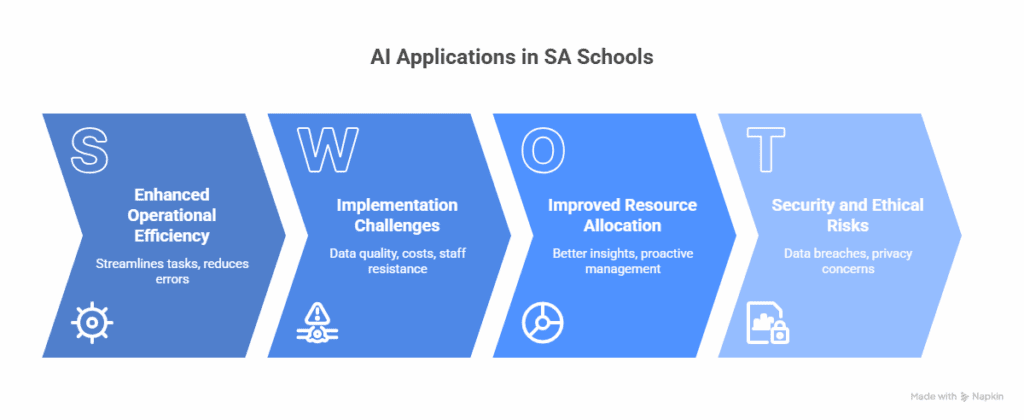
However, the adoption of AI in South African schools requires a careful balance. Implementing AI solutions without proper governance, staff training, or attention to equity can exacerbate existing challenges, particularly in under-resourced schools. Understanding both the benefits and risks is therefore critical for effective deployment.
This blog explores six practical ways AI in schools can support South African education in 2025, highlighting real-world applications, potential benefits, and risks. It also provides actionable insights for administrators and bursars who are considering AI solutions for finance, administration, student support, and security. By examining these applications, school leaders can make informed decisions that leverage AI to enhance operational efficiency, improve learner outcomes, and support ethical and sustainable practices.
Table of Contents
1. Finance Automation & Predictive Budgeting
What it means
AI tools can automate routine finance tasks (invoice matching, payment scheduling, reconciliation), detect anomalies (fraud, overspending), and use predictive analytics to forecast costs, cash flows, and revenue (including from fees, government grants, donor funding).
Use cases in SA schools
- Automating the matching of purchase orders to invoiced amounts and supplier statements, freeing bursars’ teams of manual checking.
- Forecasting impacts of inflation (utilities, salaries), so budgets can better accommodate rising costs.
- Detecting patterns of late payments by parents/stakeholders to anticipate cash‐flow shortfalls (or identify those who may need payment plans).
Benefits
- Saves time and reduces human error.
- Allows more accurate budgeting and planning, with the capacity to run “what‐if” scenarios.
- Frees up staff to focus on strategic tasks rather than purely transactional ones.
Risks/challenges
- Data quality: garbage in, garbage out. If historical data is messy, predictions will be poor.
- Cost of implementation and maintenance (software, integration, training).
- Regulatory compliance (e.g. POPIA for personal data used in predictive models; public accountability).
- Model bias: e.g. if prediction tools penalise certain wards/zones because of historical under‐funding or poverty, reinforcing inequity.
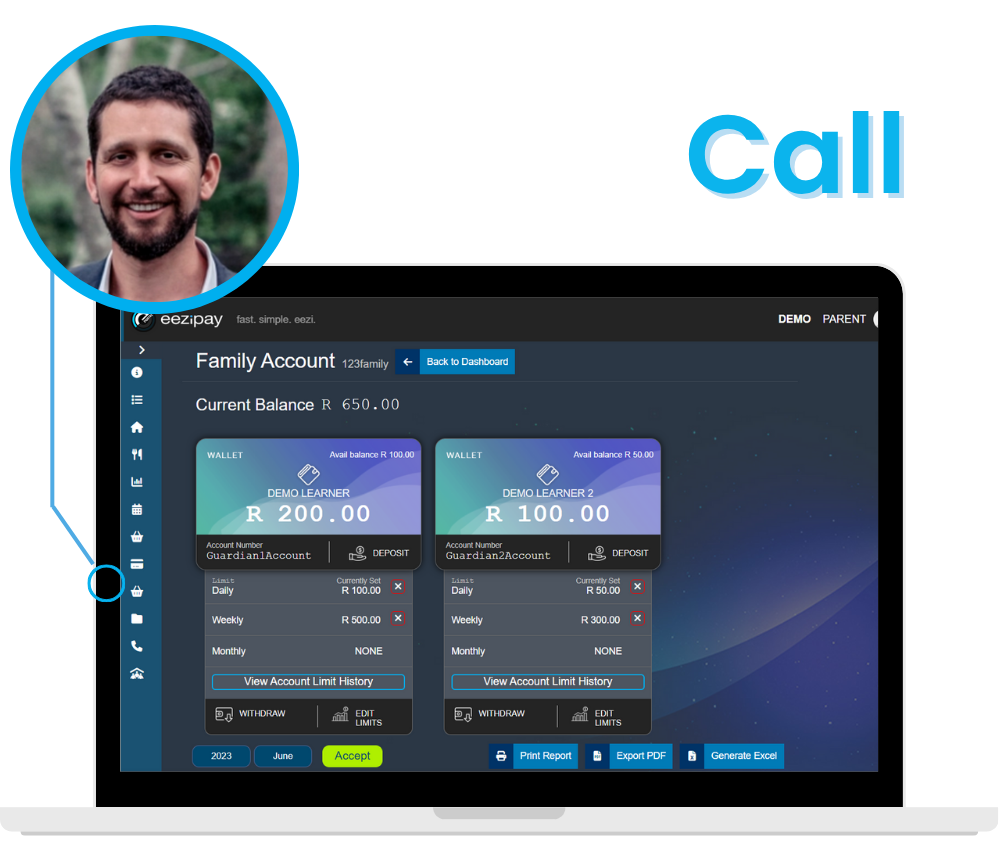
AI can streamline fee collections and payment reconciliations, supporting the move toward cashless schools in South Africa and reducing administrative workload for bursars.
These finance-focused applications demonstrate how AI in schools is transforming budgeting and collections, while reducing the workload of bursars.
2. Administrative Workflows & Document Automation
What it means
Using AI to streamline administrative ledger, correspondence, scheduling, HR tasks, admissions, reporting, maintenance requests, timetables, etc. Tools include Natural Language Processing (NLP) for automating responses, optical character recognition (OCR) for digitising documents, and workflow engines to trigger tasks automatically.
Use cases in SA schools
- Automatically generating standard letters (fee statements, reminders, official notices), based on templates, saving administrative time.
- Using OCR + AI to digitise and index old records (student files, financial documents), enabling easier retrieval and reducing physical storage needs.
- AI‐driven scheduling: timetabling classes, allocating rooms, staff, etc., taking into account constraints (teacher availability, classroom capacity, specialist labs).
Benefits
- Administrative overhead drop; faster response times; fewer delays.
- Improved record keeping, easier audits.
- Better resource allocation (rooms, staff, assets) and reduced conflicts in scheduling.
Risks
- Dependence on reliable digital infrastructure: electricity, backup, connectivity.
- Risk of errors in template generation (if content is not reviewed) or poor OCR misreads.
- Staff resistance: fear of job loss or distrust of automated systems.
By integrating AI with an all-in-one school payments system, schools can automate routine administrative tasks, from scheduling to fee management, improving efficiency and accuracy.
By digitising records and streamlining communication, AI in schools helps administrators save time and cut down on manual paperwork.
3. AI for Compliance, Reporting & Risk Management
What it means
AI tools can help schools comply with regulations (e.g. POPIA, financial reporting standards), produce audit trails, manage risk (fraud, non‐compliance), monitor safety, and flag red flags in operations.
Use cases in SA schools
- Automated internal audits of finance records to highlight discrepancies versus budgeted expenses.
- Ensuring student/parent/staff data handling meets privacy requirements: monitoring access logs, flagging unusual requests.
- Risk dashboards: real‐time monitoring of finances, infrastructure (labs, maintenance), security risks (unauthorised access, cyber threats).
Benefits
- Reduces risk of fines or reputational damage from non‐compliance.
- Enables proactive rather than reactive management.
- Improves transparency for boards, parents, and government agencies.
Risks
- Complexity in interpreting AI alerts; risk of false positives/negatives.
- Cost of hiring or training staff able to interpret AI output and respond appropriately.
- Security risk: if AI systems themselves are breached, sensitive data could be exposed.
Strong compliance tools demonstrate how AI in schools can protect data and build trust.
4. Chatbots & Virtual Assistants for Student, Parent, and Staff Services
What it means
Use conversational AI (chatbots / virtual assistants) to provide support for frequent queries—fee enquiries, HR or payroll questions, library hours, student mental health, after‐hours help, etc.
Use cases in SA schools
- A 24/7 helpdesk chatbot on the school website or app to answer parents’ queries about fees, payment deadlines or school events.
- Chatbots for students to get reminders (homework, tuition payment, events) or to ask general academic or non‐academic questions.
- Virtual assistants for staff: e.g. on leave application process, policy queries, HR forms.
Benefits
- Improves service responsiveness; less backlog in common enquiries.
- Reduces load on administrative staff, especially outside peak hours.
- Can be tailored to multilingual contexts (important in SA) to improve accessibility.
Risks
- Incorrect or misleading advice may occur if the AI is poorly configured or trained.
- Potential for misinformation (“hallucinations”), especially with generative models.
- Data privacy and security: conversations may capture sensitive info.
- Acceptance: Some parents/students may distrust automated responses vs human ones.
Chatbots highlight another way AI in schools improves communication with parents and learners.
5. Student Support, Learning & Assessment Tools
What it means
One of the most promising uses of AI in schools is in personalised learning and assessment. AI assisting in teaching and learning: adaptive learning platforms, intelligent tutoring systems, automated assessments, plagiarism detection, personalised learning paths, and predictive identification of students at risk.
Use cases in SA schools
- Adaptive learning platforms in Maths or English that adjust content difficulty based on student performance.
- Tools to analyse learner data (attendance, grades, engagement) to flag learners falling behind early, allowing for intervention (remedial classes, extra support).
- Automated marking of multiple-choice or short-answer tests, plus detection of plagiarism in essays.
Benefits
- More tailored instruction; support for struggling learners.
- Faster turnaround on assessment and feedback.
- Helps maintain academic integrity; frees teachers to focus on pedagogy and mentoring.
Risks
- Bias: e.g. adaptive systems might disadvantage learners from non‐standard backgrounds if the training data is not representative.
- Overreliance on AI feedback undermines teacher insight / human touch.
- Costs and access: Many good tools require reliable internet and devices for learners.
- Risk of cheating via misuse of AI tools; ethical considerations.
6. Security, Infrastructure Monitoring & Digital Safety
What it means
AI can monitor both physical and digital safety of the school: cybersecurity, network monitoring, equipment maintenance, and even physical security (smart cameras, access control). Also uses of AI to ensure digital safety (filtering content, protecting student data).
Use cases in SA schools
- AI‐driven cybersecurity tools to monitor the school network for attacks, phishing attempts, and malware.
- Predictive maintenance for infrastructure: e.g. detecting possible faults in electrical installations, water systems or labs using sensors and IoT + AI analytics.
- Digital safety filters: ensuring that students do not access inappropriate content online and monitoring for cyberbullying or harmful interactions on social media.
Benefits
- Better protection of sensitive information (student records, financial data).
- Avoiding costly breakdowns by catching issues early.
- Safer learning environment, both online and offline.
Risks
- Privacy concerns (especially with video surveillance or monitoring).
- Cost of hardware, sensors, upkeep.
- Dependence on third parties; risk of vendor lock‐in.
- Ethical issues: surveillance misuse, student and staff rights.
Implementation Advice: What School Leadership Needs to Prioritise
To make these AI applications viable, school administrators and bursars should:
- Assess Digital & Infrastructure Readiness
- Ensure reliable internet, power backup, and devices.
- Local or cloud data storage and processing capacity, while ensuring compliance with the Protection of Personal Information Act (POPIA).
- Start Small, Pilot, Monitor & Scale
- Begin with one or two use cases of AI in school (e.g., automating fee reminders or implementing a small pilot project for a chatbot.
- Monitor outcomes, measure KPIs (time saved, error rates, satisfaction), and adjust before scaling.
- Choose Vendors Carefully
- Select vendors with a good track record, security, ethical AI practices, and transparency in how their models are trained.
- Prefer vendors that respect data privacy, have local support, and can customise for multilingual, uneven bandwidth contexts.
- Build Staff Capacity & Buy-In
- Train staff not just in how to use tools, but in understanding how AI makes decisions (so they can spot errors or bias).
- Engage administrators, teachers, bursars, and parents in recognising the risks and limitations, as well as the benefits.
- Governance, Policy & Ethics
- Have clear policies on data collection/use/sharing.
- Create oversight (committees) to approve AI projects, monitor for bias, privacy threats, and ethical issues.
- Ensure that the use of AI aligns with national policy and educational standards.
- Ensure Equity & Accessibility
- Be careful not to deepen the digital divide: ensure learners in under-resourced areas can access tools.
- Consider cost-sharing, grants, or partnerships to provide devices or connectivity.
Clear governance ensures that the benefits of AI in schools are realised without compromising ethics.
Real Examples / Emerging Trends in South Africa & Africa
- Foondamate: a WhatsApp‐based AI tutor in South Africa helping learners who have limited access to resource-rich environments.
- Studies show personalised AI learning systems and intelligent tutoring are starting to emerge in SA, helping with adaptive lesson planning and administrative efficiencies.
- Evidence from other African low–and middle-income countries (LMICs) suggests that even quite basic AI (tutorship through low-bandwidth/chat) can make significant gains in student achievement. For example, an intervention in Ghana where students used an AI tutor via WhatsApp had statistically significant improvements in maths scores.
Looking Forward: What to Watch in 2025–2026
AI in schools is set to play a pivotal role in shaping future policies, teacher training, and equitable access to technology across South Africa.
- Growth of locally trained AI models that understand local languages and contexts (important for South Africa’s multilingual learners).
- More regulatory clarity and perhaps guidelines specifically for AI in education, including how to audit models and how to ensure fairness.
- Increased investment in AI literacy for school leaders, bursars and teachers—not only “how to use” but critical thinking about AI: where it may fail.
- Partnerships between government, universities, edtech providers, and NGOs to provide subsidised access to AI tools in poorly resourced areas.
Conclusion: Why AI in Schools Matters in 2025
AI offers real, powerful advantages for South African schools: from automating finance and compliance to improving student support and securing infrastructure. But it isn’t a magic wand. Success depends on strong governance, equity considerations, thoughtful implementation, and ongoing monitoring.
As administrators or bursars, you’re uniquely placed to ensure that your school uses AI not just because it is possible, but because it works—with transparency, ethics, and real benefit. If done right, AI in schools across SA in 2025 can help shift many of the burdens of administration and inefficiency, allowing more focus on what matters: learning, equity, and quality education.
For schools exploring broader digital transformation beyond AI, a good next read is our post on Cashless Schools in South Africa: Why It’s Time to Rethink Cash