The Financial Risks of Legacy Clocking Systems
The vulnerabilities of traditional time tracking extend beyond direct financial loss. Relying on paper, punch cards, or swipe cards introduces several significant business risks:
- Inflated Payroll Costs: “Buddy clocking” is the most direct form of time theft. Every hour paid to an absent employee directly impacts your bottom line. Annually, across multiple employees, these costs can accumulate to tens of thousands of Rands.
- Excessive Administrative Overhead: Your payroll and HR departments dedicate valuable resources to manually capturing timesheet data, interpreting illegible records, and locating missing cards. This process is inefficient and diverts focus from strategic, high-value tasks.
- Data Entry Inaccuracies: Manual data entry is inherently prone to error. A single inaccuracy can lead to employee overpayment or underpayment, resulting in disputes and requiring time-consuming corrections.
- Compliance and Legal Liabilities: Inaccurate attendance records represent a major liability during audits or labour disputes. Failure to maintain compliance with South African labour legislation regarding work hours and overtime can lead to significant financial penalties.

The Technology Behind Biometric Time and Attendance Systems
A biometric clocking system eliminates these challenges by linking attendance directly to a unique biological identifier—a credential that cannot be lost, forgotten, or shared. The verification process is both seamless and efficient.
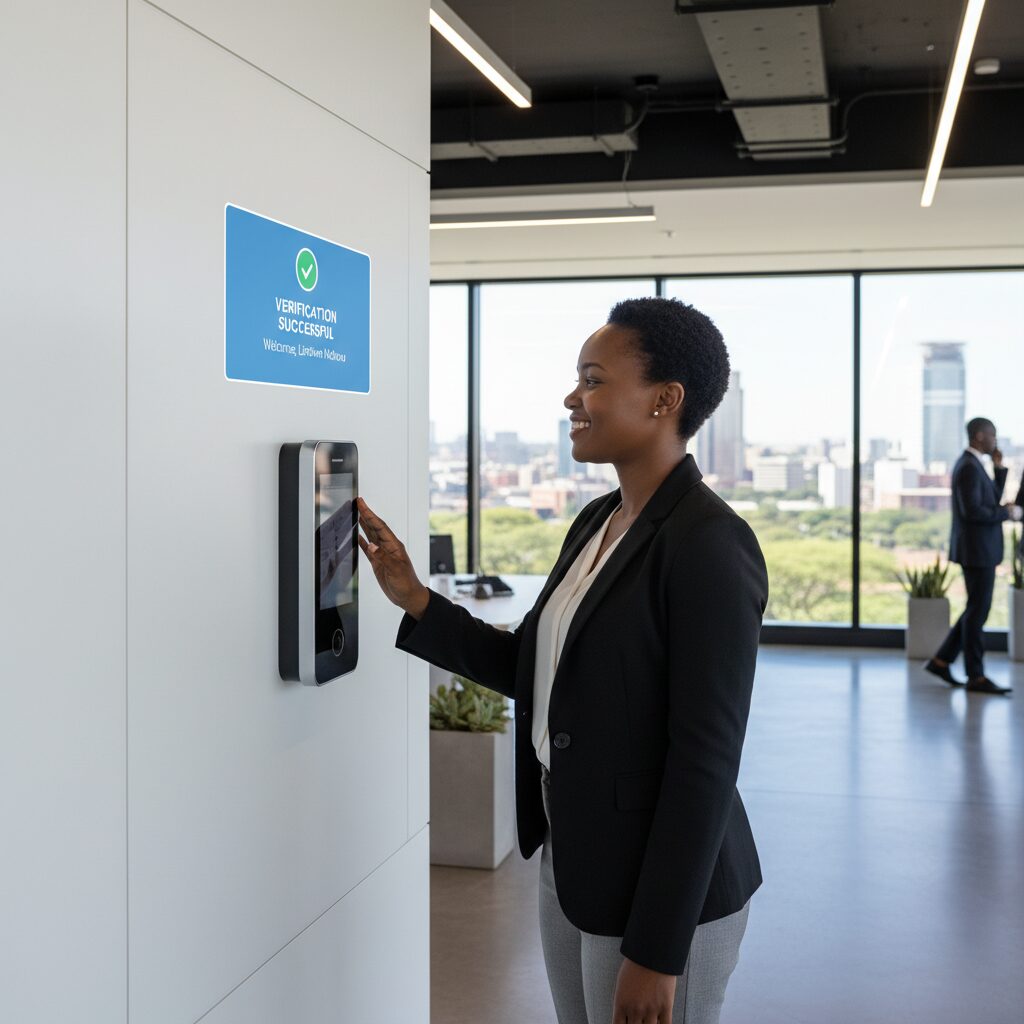
An employee’s unique characteristic, such as a fingerprint or facial geometry, is enrolled and encrypted within the biometric clocking system. To clock in or out, the employee simply presents their biometric identifier to the terminal. The device captures the data, validates it against the stored record, and instantly verifies their identity before recording a precise timestamp.
This data is then securely transmitted to the time and attendance software, generating a real-time, immutable digital record. Leading South African solutions, such as those from Africlock, are engineered to manage local compliance requirements and deliver robust, reliable tracking.
Key Benefits of a Biometric Clocking System
Upgrading to a biometric clocking system delivers a powerful return on investment through enhanced accuracy, efficiency, and security.
1. Eradicate Time Theft and “Buddy Clocking”
This is the most critical advantage of these clocking systems. A biometric platform verifies the actual person, not an object they possess. It is functionally impossible for one employee to clock in for another, as a fingerprint or facial profile cannot be transferred. This feature immediately eliminates time theft and ensures your wage bill accurately reflects hours worked.
2. Streamline Payroll Administration
As clocking data is captured digitally with 100% accuracy, the manual workload for your payroll team is virtually eliminated.
- Automated Data Capture: Data flows automatically from the clocking terminal to the management software, removing the need for manual entry.
- Reduced Errors and Disputes: The system provides an irrefutable log of user activity, preventing payroll disputes and simplifying resolution.
- Seamless Payroll Integration: Modern biometric platforms integrate directly with major South African payroll packages like Pastel Payroll and VIP Payroll, enabling you to process salaries with maximum efficiency.
3. Ensure Data Accuracy and Legislative Compliance
Every clock-in and clock-out event is logged with a precise, immutable timestamp. This functionality creates a perfect audit trail, ensuring your organisation remains fully compliant with the Basic Conditions of Employment Act. You gain immediate access to accurate records for overtime calculations, leave management, and any potential CCMA proceedings.
4. Strengthen Physical Access Control
Many biometric terminals can serve a dual purpose, functioning as both a time and attendance system and an access control device. This allows you to leverage the same platform to restrict access to sensitive areas such as server rooms, stockrooms, or executive offices, ensuring only authorised personnel can gain entry.
Selecting the Optimal Biometric Clocking System
When selecting the right biometric clocking system, evaluate your organisation’s unique operational environment and the total cost of ownership.
Hardware: Fingerprint vs. Facial Recognition
- Fingerprint Scanners: These are the most widely adopted and highly reliable terminals for office, retail, and manufacturing environments.
- Facial Recognition Terminals: This technology is an excellent solution for industries where employees’ hands may be compromised by dirt, moisture, or wear, such as in construction, mining, or agriculture. It provides a touchless, hygienic clocking experience.
Software: The Central Management Platform
The hardware is only one component of the solution; the software platform delivers the strategic value. Prioritise clocking systems from providers like CDC Business Systems, which offer proprietary software without recurring monthly license fees. This model can significantly lower the long-term cost of your system. Ensure the software offers an intuitive user interface, provides real-time reporting, and integrates with your existing payroll package.
Integration and Support
Your choice of technology should solve problems, not create them. That is why the ideal biometric clocking system must integrate flawlessly with your current payroll software, bridging the gap between physical attendance and digital payment. Don’t settle for generic hardware; insist on a reputable South African provider who understands local challenges and offers the on-the-ground support needed to keep your operations running.
Moving past legacy clocking systems is a defining moment for your business’s efficiency. By adopting modern time and attendance systems, you are doing more than just tracking hours—you are securing your financial integrity. Eliminate time theft, automate your administration, and empower your workforce to focus entirely on strategic growth.