As South Africa accelerates towards a digitally enabled economy, the payments landscape is undergoing rapid and profound change. From the rise of mobile wallets and real-time transfers to the proliferation of contactless card payments, digital innovation is reshaping how individuals and businesses transact. Yet amid this transformation, one form of payment continues to endure: cash.
While digital payment methods offer speed, security, and convenience, cash remains deeply rooted in the daily lives of millions — especially in informal markets, rural communities, and low-income segments. The future of money in South Africa is not about elimination, but about coexistence. For enterprise and retail decision-makers, the challenge lies in balancing innovation with inclusion, ensuring no customer is left behind as the economy evolves.
This blog explores how businesses can navigate this dual-reality economy, why cash still matters, and how hybrid payment systems may hold the key to sustainable growth and resilience in the years ahead. These shifts are central to understanding the future of money in a transforming economy.
Table of Contents
Cash in a Digitally Rising Economy
Over the past five years, South Africa has seen remarkable growth in digital payment adoption. Electronic funds transfer (EFT) transactions have grown from R4.82 trillion in 2010 to approximately R12.9 trillion as at March 2025, while PayShap volumes have grown from 9 million in 2023 to over 250 million in early 2025.
Innovations like Capitec Pay, contactless card terminals, and mobile wallets from Vodacom and MTN have brought secure, convenient transactions to millions of users.
Yet despite this progress, cash still accounts for more than 56% of all transactions by volume in South Africa. While its share of total value is much smaller (just over 20%), cash remains king for small, daily purchases — from informal traders to taxi fares and household essentials.
This duality is at the heart of the future of money in South Africa and underscores the need for payment strategies that reflect both technological advancement and social realities.
Why South Africans Still Trust Cash
Understanding the resilience of cash requires more than data — it requires context. Cash is tangible, universally accepted, and doesn’t require data, electricity, or a smartphone. For many, especially those in lower-income or rural communities, it represents control, predictability, and trust.
Several studies show that many consumers still withdraw over half their income in cash — even if that income is paid into a bank account. Key drivers include:
- Perceived convenience
- Lower cost — no data or transaction fees
- Widespread acceptance, particularly in informal markets
- Concerns about digital fraud or unauthorised debits
Importantly, many of these concerns are not unfounded. Issues like debit order abuse, cyber scams, and load-shedding-induced network failures can make digital methods feel riskier or unreliable. These trust factors shape the future of money for millions of South Africans.
Cash as a Tool for Financial Inclusion
South Africa’s financial inclusion rate exceeds 94%, and over 82% of adults have access to a bank account. Yet access alone doesn’t guarantee adoption. The future of money must account for this nuance.
The continued use of cash is often linked to:
- Low-value, high-frequency transactions
- Budgeting habits using the envelope system
- Informal employment and trade, which operate primarily in cash
- Infrastructure gaps — unreliable connectivity and power outages make digital tools impractical in some areas
For these reasons, regulators like the South African Reserve Bank (SARB) have taken a clear stance: while digital payments are a priority, a fully cashless economy is not the goal. Instead, SARB advocates for an inclusive, hybrid system that ensures no one is excluded from participating in the economy. That hybrid reality defines the future of money in this region.
A Hybrid Future: The Smart Strategy for Enterprises
For large enterprises, financial institutions, and national retailers, the move toward cashless doesn’t require abandoning cash; it requires integrating it strategically with digital solutions. The future of money is hybrid.
Benefits of a Hybrid Payment Model
1. Operational Efficiency
Digital systems streamline reconciliation, reduce cash-handling costs, and provide real-time reporting. But having cash capabilities ensures continuity during infrastructure failures or network outages.
2. Inclusive Customer Reach
A hybrid system accommodates both the digitally savvy and those who still depend on cash, including the 11 million South Africans who are unbanked or underbanked.
3. Revenue Growth Opportunities
Multi-channel offerings can increase basket sizes and allow for services like airtime top-ups or bill payments, particularly valuable in township retail environments.
4. Business Resilience
With power and connectivity disruptions still common, maintaining both cash and digital options protects revenue flow and customer trust.
Implementing Hybrid Systems: Real-World Examples
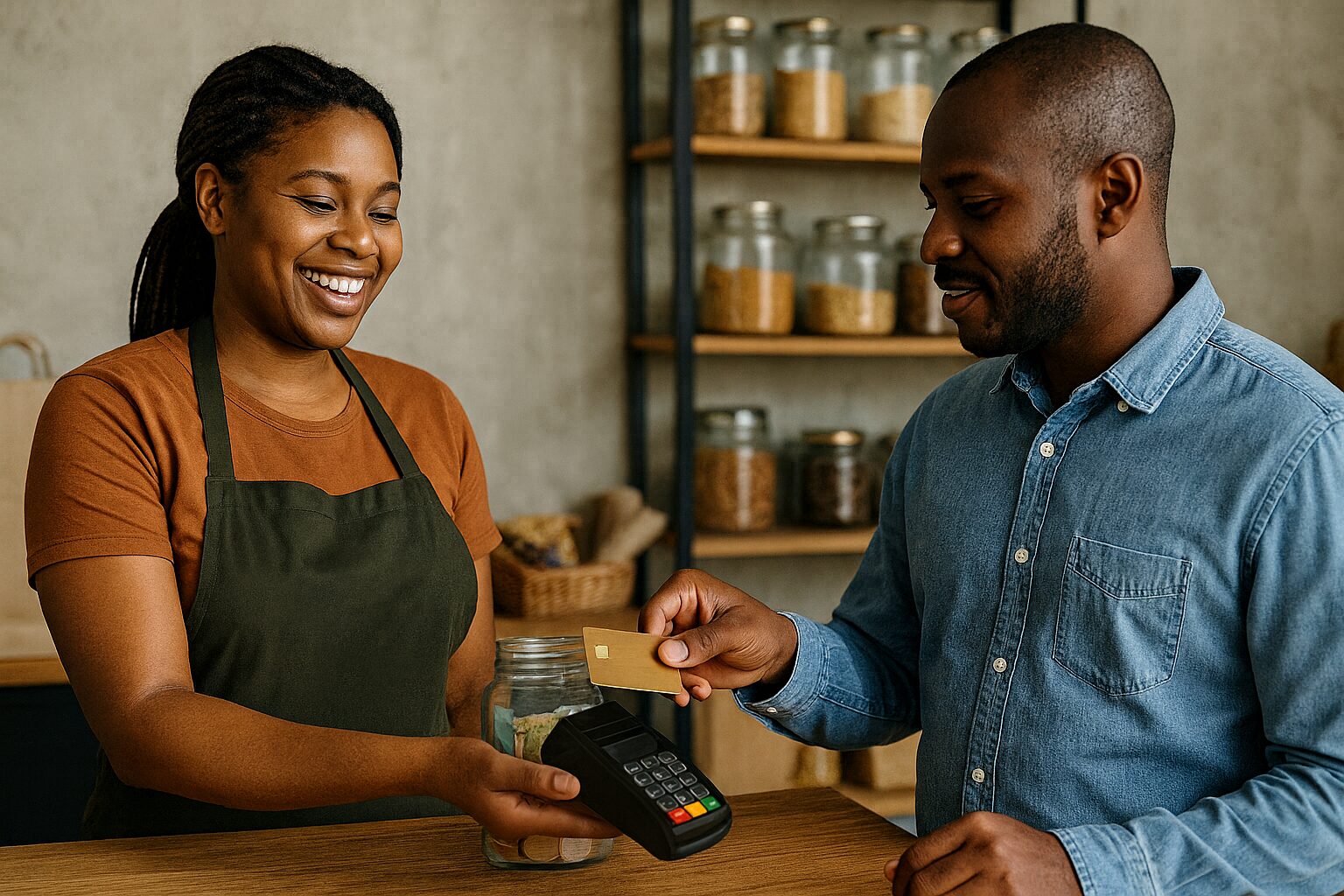
Across South Africa, businesses are already blending traditional and modern payment options to meet customers where they are. This shift is visible across sectors and is shaping the future of money in practice:
- Pick n Pay now accepts cryptocurrencies and mobile wallets alongside cash and cards.
- RCS has integrated credit, QR, and contactless solutions across e-commerce and in-store channels.
- Stellenbosch University implemented SnapScan to reduce cash usage while maintaining cash-handling options for accessibility.
- Mobile wallet platforms like Vodapay and MTN MoMo enable even informal traders to accept digital payments — a critical step toward broader financial inclusion.
These examples illustrate that hybrid models are not just theoretical — they are already in motion. They demonstrate how digital innovation can extend inclusion rather than replace existing systems. As more companies follow suit, they directly shape the country’s future of money.
For a deeper look at sector-specific cashless adoption, see why many schools are moving toward a cashless future.
What Businesses Should Do Next
To succeed in South Africa’s complex payments environment, decision-makers must adopt a pragmatic, inclusive, and adaptive mindset. A one-size-fits-all approach will likely alienate portions of the customer base and expose the business to operational vulnerabilities. Instead, leaders should:
- Invest in integrated, flexible POS infrastructure that can process cards, QR, mobile, and cash to enable seamless payments across all customer segments.
- Educate staff and customers on the safe, efficient use of digital payments, dispelling fears around fraud and usability through hands-on guidance and clear communication.
- Partner with fintech providers that offer modular, cost-effective tools suitable for both formal retail chains and informal sector merchants.
- Monitor infrastructure limitations and ensure contingency plans are in place for power or signal interruptions.
- Avoid phasing out cash too rapidly, particularly in regions or customer segments with low digital readiness or high distrust in formal systems.
Ultimately, embracing a multi-channel payment strategy aligns with evolving consumer behaviour while staying grounded in real-world usage patterns and inclusion goals. This approach supports long-term growth and resilience in the future of money.
Conclusion: Tradition Meets Transformation
The future of money in South Africa is not a binary choice between old and new — it’s a spectrum. As digital payment systems mature and financial literacy improves, more consumers will naturally shift to digital tools. But cash still holds cultural, practical, and economic relevance for millions.
For enterprises, the imperative is clear: build systems that are agile, inclusive, and responsive to a diverse customer base. By balancing innovation with empathy, South African businesses can lead the way in shaping a future that includes everyone — whether they tap, swipe, scan, or pay in notes.
Solutions like Eezipay, which offer inclusive digital infrastructure across education, retail, and service environments, are quietly laying the foundation for a South African economy where money works for everyone.
For more on this shift, explore key takeaways from Going Cashless in South Africa: 5 Critical Lessons for Enterprises to understand how digital transformation intersects with customer expectations, inclusion, and long-term business resilience.