
Understanding the Distinction: NSFAS vs. Bursaries
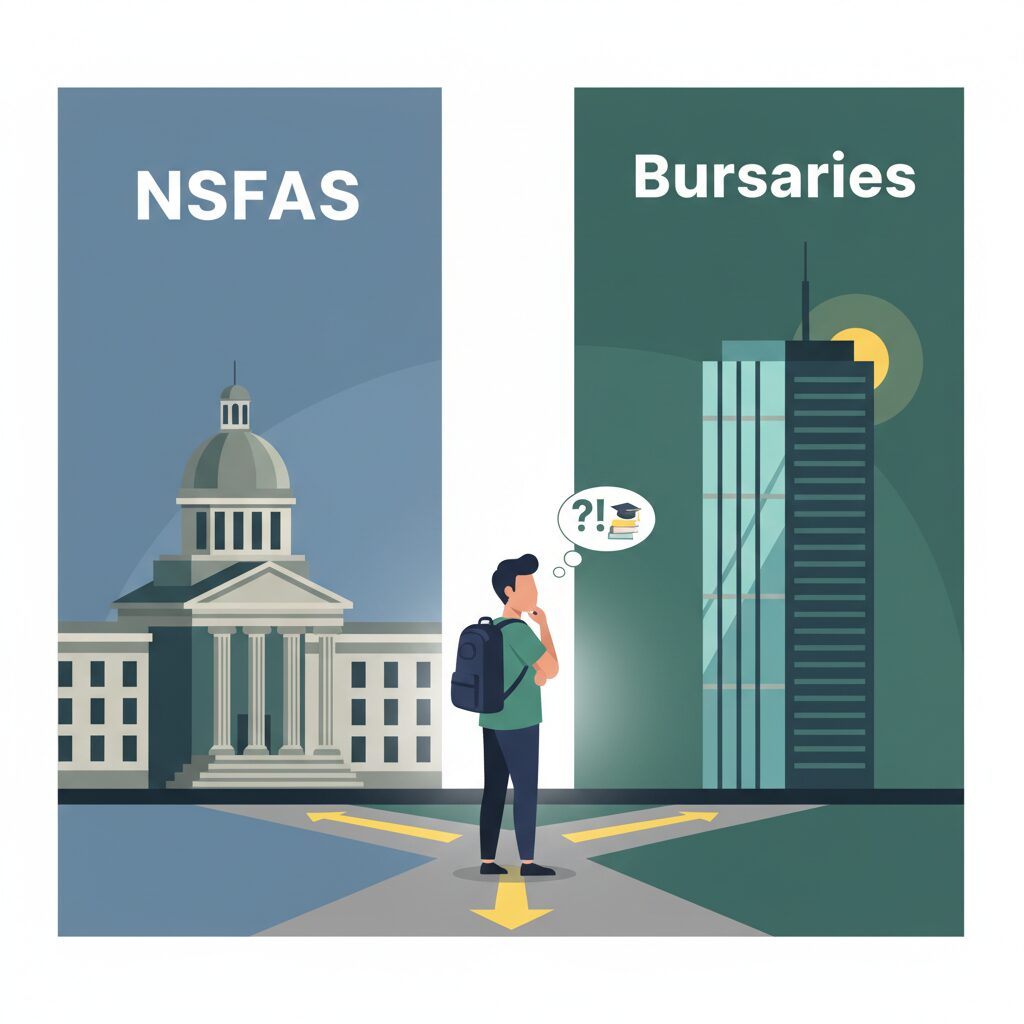
Although the terms are often used interchangeably, it is crucial to understand the distinction between “NSFAS” and a “bursary.” This knowledge is fundamental to effective financial planning for tertiary education.
What is NSFAS?
NSFAS is a government-funded entity structured to provide financial aid to students from low-income households. While it operates as a bursary for qualifying students who maintain requisite academic standards, it is technically a loan that converts into a non-repayable bursary upon meeting these conditions. This funding is specifically for students enrolled at one of South Africa’s 26 public universities or 50 TVET colleges. As confirmed by official government sources, the scheme covers costs for tuition, registration, and provides allowances to cover living expenses, transportation, and learning materials.
What is a Bursary?
A bursary is a non-repayable grant awarded to a student to fund their studies. These are offered by a diverse range of sources, including private corporations (such as financial and engineering firms), foundations, NGOs, and the universities themselves. In contrast to NSFAS’s primary focus on financial need, traditional bursaries are typically awarded based on a combination of criteria, including:
- Exceptional academic merit (e.g., achieving high matriculation results).
- Enrolment within a specific, high-demand field of study.
- Demonstrated financial need.
- Some bursaries include a work-back provision, which contractually obligates the recipient to work for the funding organization for a predetermined period post-graduation.
Key Differences at a Glance
| Aspect | NSFAS Funding | Traditional Bursary |
|---|---|---|
| Repayment | Non-repayable, contingent on meeting academic progression requirements. | Non-repayable; some may include work-back provisions. |
| Primary Criteria | Financial need, determined by household income. | Primarily academic merit, often within a specified field of study. |
| Source | South African Government. | Private corporations, NGOs, universities. |
| Coverage | Restricted to public universities and TVET colleges. | May extend to private higher education institutions. |

Eligibility Verification: Key Funding Requirements
Ensuring all minimum requirements are met is a prerequisite for a bursary application.
NSFAS Eligibility Criteria
Eligibility for NSFAS funding is contingent upon meeting all of the following criteria:
- Must be a South African citizen or permanent resident.
- Belong to a household with a combined annual income not exceeding R350,000.
- Applying to or currently enrolled at a public university or TVET college.
- First-time applicants must have a confirmed acceptance from the institution.
- Continuing students must satisfy the academic progression requirements defined by the institution and NSFAS.
A comprehensive list of requirements is available on the official NSFAS website.
General Bursary Eligibility
Eligibility for other bursaries varies substantially among providers. However, common requirements include:
- A robust academic record, often with specified minimum percentage requirements (e.g., an aggregate of 70% or higher).
- Enrolment in a specific field of study that aligns with the funder’s strategic objectives (e.g., engineering, accounting, medicine).
- A comprehensive application package, typically including a letter of motivation and official academic transcripts.

The Application Process: A Step-by-Step Framework
A successful bursary application is predicated on meticulous preparation and attention to detail.
The NSFAS Application Process
The NSFAS application is a completely digital process managed via the official portal. While application dates are subject to annual review, they are typically announced in the second half of the year for the subsequent academic year.
- Create a Profile: Applicants must create an account on the myNSFAS portal to kickstart the process. However, managing multiple logins can become overwhelming as you juggle your financial aid status and your university studies. To stay organized, many successful students use a centralized strategy to unlock your student portal login. This essential guide helps you track your marks and funding in one place, ensuring that your bursary application data remains synced with your academic progress throughout the year.
- Document Preparation: Applicants must prepare high-resolution digital copies of several key documents. These generally include a South African ID or birth certificate, parents’/guardians’ IDs, and a signed NSFAS Consent Form for income verification.
- Complete the Online Application: Accurately complete all sections of the online form and upload the required documentation to prevent processing delays.
- Submission: Verify all entered information for accuracy before submitting the application prior to the official deadline.
Sourcing and Applying for Other Bursaries
Securing external bursaries requires a proactive and strategic search.
- University Financial Aid Departments: Review your university’s official website, as these departments frequently list available bursary opportunities.
- Bursary Aggregator Platforms: Websites like `bursaries-southafrica.co.za` serve as centralized databases for available financial aid opportunities.
- Corporate Websites: If you have a target career sector, investigate the websites of major corporations within that industry to identify student funding programs.
For these applications, a compelling letter of motivation and a complete record of academic performance are almost universally required.
Post-Application Procedures
Post-submission, it is imperative to monitor the application’s status.
Checking Your Bursary Application Status
For NSFAS, application outcomes are tracked via the myNSFAS portal. As reported by the SA Government News Agency, all application statuses are communicated directly to students through this integrated platform.
The Appeals Process
In the event of an unsuccessful NSFAS application, candidates have the right to initiate an appeal. The appeal must be submitted through the myNSFAS portal within 30 days of receiving the application outcome. It is critical to provide all supplementary documentation requested to substantiate the appeal. For a detailed walkthrough, see this step-by-step guide to NSFAS appeals.
Securing Your Future
While learning how to apply for a bursary can feel like a daunting task, it is a structured and manageable journey that paves the way to your degree. By understanding the distinction between NSFAS and private financial aid, verifying your eligibility, and submitting a meticulous application, you significantly optimize your chances of a fully-funded education.
Remember, securing your funding is only the first step. Once your tuition is covered, your next priority is finding a safe, conducive environment where you can actually focus on your studies. To help you navigate the next phase of your journey, we’ve put together a comprehensive look at Student Accommodation in South Africa: The Best 2026 Guide.
From choosing the right residence to understanding how your allowances cover your stay, this guide ensures that once your bursary is approved, you have the perfect place to call home while you build your future.