
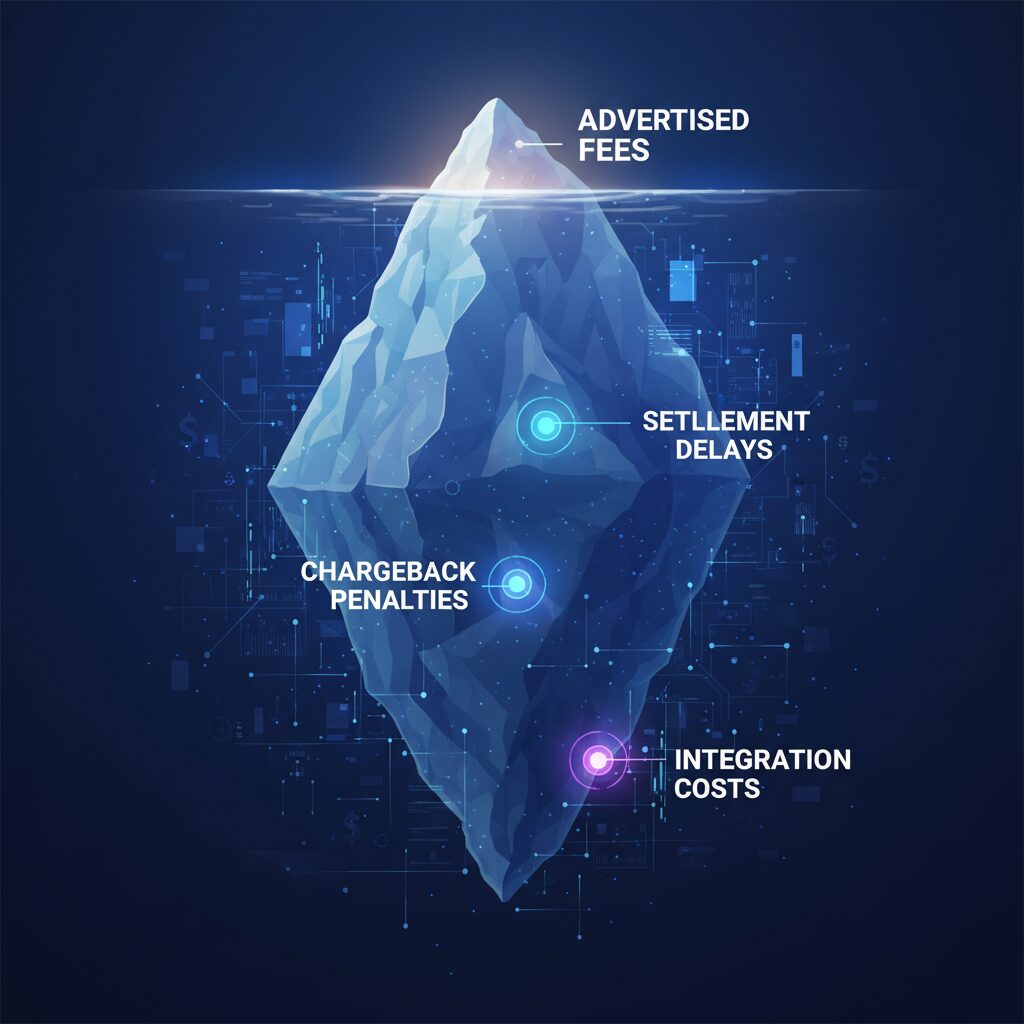
Choosing a provider based only on payment gateway fees South Africa companies advertise is a common mistake that can cost your business thousands in lost margins every year. While a low transaction percentage looks attractive on a landing page, it often hides a complex ecosystem of settlement delays, payout costs, and manual admin work that quietly erodes your profitability. Our goal is to help you look past the marketing surface to calculate the only figure that truly matters: your Total Cost of Ownership (TCO).
In this guide, you will discover how to deconstruct your monthly statement to find the “hidden” costs that standard pricing models ignore. We provide a practical mathematical comparison of South Africa’s leading gateways for 2026 and introduce a modular framework to help you choose a partner that scales alongside your business without sacrificing your cash flow.
Beyond the Percentage: Deconstructing Payment Gateway Fees South Africa
Before we dive into the hidden expenses, we must first clarify the standard payment gateway fees South Africa providers typically list. Understanding these basic components is the first step in building an accurate Total Cost of Ownership (TCO) model.
- Setup Fees: A once-off cost to establish your merchant account. Most modern South African gateways, including Yoco, Paystack, and Ozow, have eliminated these fees, but it is critical to verify this before entering into any agreement.
- Monthly Fees: A fixed subscription fee charged on a recurring basis, irrespective of transaction volume. Many leading providers have transitioned to a “pay-as-you-go” model with zero monthly fees, which is optimal for new or seasonal enterprises.
- Transaction Fees: The most frequent cost, usually made up of two parts: a percentage of the sale and a fixed fee per transaction.
Example: On a R1,000 sale with a fee of “2.9% + R1.00”, your total cost is R30.00 (R29.00 + R1.00).
While these fees are significant, they represent only one part of the equation. The most substantial financial impact often originates from costs that are not immediately apparent.
The Hidden Costs That Impact Your Profit Margin
These are the variables that separate a gateway that looks cheap from one that is truly profitable. To manage your business effectively, you must put a clear Rand value on these hidden costs.
The Cost of Delays: Settlement Periods & Cash Flow Impact
The time required for customer payments to be deposited into your bank account is the “settlement period,” and it carries a tangible monetary cost. Capital that is “in transit” is unavailable for inventory procurement, payroll, or marketing investments. This is defined as opportunity cost.
It can be calculated as follows. If a gateway holds your funds for an additional two days and your annual cost of capital (e.g., the interest on a business loan) is 12%, the formula is:
Annual Cash Flow Cost = (Average Daily Sales) x (Number of Delay Days) x (Annual Cost of Capital)
For an organization with a R100,000 monthly turnover (R3,333/day), a 2-day settlement delay at a 12% cost of capital equates to an annual opportunity cost of R799. Certain gateways like Ozow provide instant settlement, whereas others may require 2-3 business days.
The Impact of Payouts, Refunds, and Payment Gateway Fees South Africa
Nominally small, fixed fees can aggregate into significant annual expenses.
-
Payout Fees: Some gateways charge you to transfer your own money into your business bank account. PayFast, for example, charges R8.70 per payout. If you withdraw your funds weekly, this adds an extra R452 per year just to access your earnings.
-
Refund Costs: When a customer asks for a refund, you lose more than just the sale. Most gateways keep the original transaction fee, and some charge an extra fee to process the return. This means a single R500 refund could actually cost your business R15–R20 in lost processing fees.
-
Chargeback Penalties: A chargeback happens when a customer disputes a transaction through their bank. If you lose the dispute, you lose the product and the revenue, plus you are charged a penalty fee that often exceeds R100.
Integration and Maintenance: The Operational Cost of Technology
How efficiently does the gateway integrate with your e-commerce platform (such as Shopify or WooCommerce)? A complex integration may necessitate significant developer hours. Furthermore, ongoing maintenance for custom API solutions requires dedicated technical resources. While less of a concern for standard plugin-based implementations, this is a critical TCO component for organizations with bespoke digital platforms. A valuable overview of integration options for platforms like Shopify can be found in this complete guide to Shopify Payment Gateways in South Africa.
The VAT Factor: A Quick Check for Small Businesses
Most payment gateway fees South Africa are advertised “Excluding VAT.” If your business is VAT-registered, this is a standard business expense you can account for. However, if you are a smaller merchant or an NGO not registered for VAT, you need to remember that an extra 15% will be added to every fee you pay. In this case, a 3% fee effectively becomes 3.45%. Always factor this in to ensure your profit margins remain protected.

The 2026 TCO Showdown: A Mathematical Comparison
To truly understand the landscape of payment gateway fees South Africa currently offers, let’s apply our TCO model to a practical scenario. We will analyze four prominent gateways using the following metrics:
- Monthly Turnover: R100,000
- Transactions per Month: 200 (Average Order Value: R500)
- Payout Frequency: Weekly (4 payouts per month)
- Refund Rate: 2% (4 refunds per month)
- Cost of Capital: 12%
(Note: Fees are based on the latest available data for 2026 and are subject to change. This model is for illustrative purposes.)
| Cost Component | Yoco | Paystack | Ozow (EFT Focus) | PayFast |
|---|---|---|---|---|
| Transaction Fee | 2.95% (no fixed fee) | 2.9% + R1.00 | 2.5% (Instant EFT) | 3.5% + R2.00 |
| Monthly Calculation | R100,000 x 2.95% | (R100,000 x 2.9%) + (200 x R1) | R100,000 x 2.5% | (R100,000 x 3.5%) + (200 x R2) |
| Monthly Transaction Cost | R2,950 | R3,100 | R2,500 | R3,900 |
| Annual Transaction Cost | R35,400 | R37,200 | R30,000 | R46,800 |
| Payout Fees (Annual) | R0 (Free) | 48 x R3 = R144 | 48 x R5 = R240 | 48 x R8.70 = R418 |
| Refund Costs (Annual) | 48 x (R500x2.95%) = R708 | 48 x ((R500x2.9%)+R1) = R744 | 48 x (R500x2.5%) = R600 | 48 x ((R500x3.5%)+R2) = R936 |
| Settlement Delay Cost | 1.5 days = R599 | 1 day = R399 | 0 days = R0 | 2.5 days = R998 |
| TOTAL ANNUAL COST (TCO) | R36,707 | R38,487 | R30,840 | R49,152 |
| EFFECTIVE RATE (TCO %) | 3.06% | 3.21% | 2.57% | 4.10% |
In simple terms, for every R100 you earn, the “Effective Rate” tells you exactly how many Rands you never see. With Ozow, you lose R2.57, while with PayFast, you lose R4.10. Over a year, that small gap becomes a R18,000 difference in your pocket.
Analysis of the Results
The TCO model reveals a financial reality that diverges significantly from headline rates. PayFast, despite its market tenure, demonstrates the highest Total Cost of Ownership by a substantial margin, driven by its high percentage fee, per-transaction charge, payout costs, and extended settlement times.
Ozow emerges as the most cost-effective solution in this specific scenario, primarily due to its competitive EFT rate and instant settlement feature, which eliminates cash flow drag. Yoco performs well with its straightforward, flat-rate structure and zero-cost payouts. Paystack remains a solid contender, although its fixed per-transaction fee renders it slightly less economical for businesses processing a high volume of low-value orders. This type of detailed TCO breakdown is essential, a point reinforced in one in-depth analysis of South African gateways.
This data provides an important evolution from our previous guide, where we recommended PayFast as a top choice for new SMEs. While PayFast remains the easiest “entry point” because it’s quick to set up and has no monthly costs, this TCO model reveals the trade-off. As your sales grow, the convenience of a quick setup is eventually outweighed by the cumulative cost of fixed fees and slower access to your funds. Essentially, what is best for a startup (low barrier to entry) is rarely what is best for a scaling business (low long-term cost). This makes reviewing payment gateway fees South Africa a critical task for any growing enterprise.
Go Beyond Basic Payments
While the data in our comparison table helps identify the most competitive transaction rates, true cost efficiency goes beyond the percentage. If your goal is to simply accept a card payment, basic tools work well. However, once you need to coordinate inventory, manage staff, or integrate specific industry tools, the “hidden cost” usually lies in the manual work required to sync different systems.
This is where the Eezipay Smart MPT Range offers a distinct advantage. You can think of it as a modular system where you select a hardware foundation and then add only the specific software modules your business requires. Whether you need Meal Booking, Events, or a full TouchPOS setup, this approach ensures you never pay for features you do not use. It effectively reduces your Total Cost of Ownership by automating the manual admin hours that typically eat into your profit.
Explore the Range: View the Eezipay Product Shop to see which hardware base fits your budget.

Choosing Your Most Profitable Partner: TCO-Based Recommendations
Your optimal payment partner is contingent upon your specific business model and how it interacts with the various payment gateway fees South Africa providers charge.
-
For Emerging Enterprises (< R80k/month): Ozow represents the most profitable choice. Its focus on competitive Instant EFT rates and immediate fund access is invaluable when keeping your cash flowing is the top priority.
-
For Scaling E-commerce (R80k – R500k/month): Yoco offers an excellent balance of cost and features. Its percentage rate automatically drops as your volume increases, while the absence of payout or fixed transaction fees simplifies your cost management.
-
For High-Value Sales (Orders over R1,500): Paystack becomes more competitive in this context. Because the sale price is high, a fixed R1.00 fee is a much smaller portion of your total cost compared to cheaper items.
-
For Subscription or Large Enterprises (>R500k/month): At this scale, standard pricing is no longer the best deal. It is advisable to engage directly with sales teams at providers like Peach Payments or your preferred gateway to negotiate a custom, volume-based rate.
The Future of SA Payments: What to Expect by 2026
The payments landscape is in a state of constant evolution. The continued adoption of real-time payment (RTP) infrastructure like PayShap will compel all gateways to offer faster, more cost-effective settlement solutions. As market competition intensifies, we anticipate further reductions in the payment gateway fees South Africa businesses pay, along with a greater emphasis on value-added services such as advanced fraud protection and multi-currency support.
The Final Calculation: Your Profitability
Mastering your gateway analysis is about so much more than just comparing percentages—it is about claiming full control over your business’s financial future. When you look at the complete picture, from lightning-fast cash flow to peak operational efficiency, you aren’t just managing costs; you are ensuring that more of your hard-earned revenue actually stays where it belongs: in your bank account.
Now that you have the “math” to protect your profits, the next step is to see which system actually fits your day-to-day operations. To help you make the right move, we have put together a detailed breakdown in our guide, Best Payment Gateway South Africa: An Ultimate Guide to the Top 5 Online Payment Methods. Think of it as your roadmap to matching these costs with the specific features—like high-speed APIs or seamless WooCommerce tools—that will help you scale without the growing pains. It is the final piece of the puzzle to ensure your digital commerce operation is built for sustained success.