
Managing cash in the workplace is increasingly inefficient and risky. From the cost of handling physical money to the administrative burden of paper meal vouchers and manual staff accounts, traditional approaches no longer meet the needs of modern organisations. As South Africa continues its shift towards digital payments, businesses across various sectors, including hospitality, agriculture, manufacturing, and corporate environments, are rethinking how staff payments are managed.
One solution addressing these challenges is the staff wallet system.
A staff wallet system enables organisations to move beyond cash, vouchers, and manual reconciliation by providing employees with secure, digital access to meals, allowances, or workplace benefits. For HR Directors, Finance Managers, and Operations Executives, this represents a practical way to reduce admin, improve control, and enhance staff experience — all while maintaining compliance.
In this guide, we explain what a staff wallet system is, how it works in practice, the benefits it delivers, and the real ROI organisations can expect from moving to a cashless workplace. We’ll also explore why closed-loop wallet models are becoming the standard for cashless workplaces in South Africa.
Table of Contents
Understanding the Staff Wallet System
What Exactly Is a Staff Wallet System?
A staff wallet system is a company-managed digital wallet provided to employees for use within a controlled workplace environment. It allows staff to make cashless payments for meals, refreshments, or internal purchases using an NFC-enabled card or mobile interface.
Unlike consumer digital wallets, a staff wallet system is designed specifically for organisational use. Funds are allocated according to company policy and can only be spent at approved locations such as on-site canteens, cafeterias, or staff shops. This structure replaces physical cash, paper vouchers, and manual tracking tools with a single, auditable digital platform.
Most workplace wallet systems operate as closed-loop solutions, meaning funds are ring-fenced and restricted to an approved ecosystem. This gives employers full visibility and control — a critical requirement when wallets are used for subsidies or staff benefits.
To understand why control and compliance matter in workplace payments, see our guide on Closed-Loop Wallet Systems: Control, Compliance, and Convenience.
How a Staff Wallet System Works in Practice
In a workplace context, a staff wallet system centralises staff spending into one secure digital workflow, simplifying payments for employees while giving employers real-time oversight.
1. Funding the Wallet
Funds are allocated based on the organisation’s chosen model. Employers may load monthly meal subsidies or benefits directly into staff wallets, either individually or in bulk. In some setups, employees may also top up their wallets, depending on company policy.
For credit-based models, spending is tracked throughout the month and reconciled via payroll at the end of the month — eliminating the need for paper slips or manual deductions.
To understand how this works operationally, explore our Payroll Integration with Staff Wallets guide.
2. Making Payments
Employees pay at approved locations by tapping their NFC card or mobile app at an enabled point-of-sale device. Transactions take seconds, with the amount deducted instantly from the wallet balance. Because the system is closed-loop, spending is automatically restricted to authorised merchants and categories.
3. Managing and Reporting
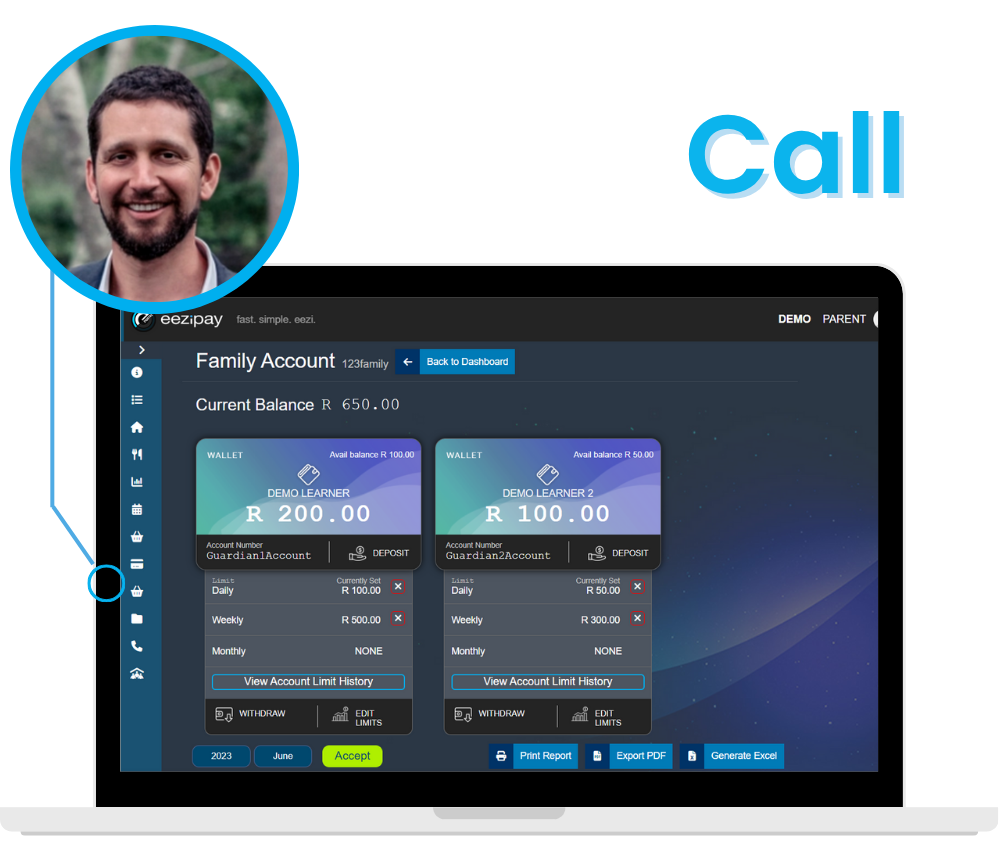
All transactions are recorded in real time and displayed in a central admin portal. HR, Finance, and Operations teams can generate payroll-ready reports, monitor usage patterns, and maintain clear audit trails, supporting compliance with South African payroll, tax, and data-protection requirements.
Benefits of Using a Wallet System for Staff
Implementing a staff wallet system in the workplace delivers immediate and practical benefits for both employees and the organisation. By replacing cash, vouchers, and manual tracking with a digital platform, staff wallet systems improve efficiency, transparency, and daily experience across the workplace.
1. Simplified and Cashless Staff Payments
A staff wallet system removes the need for physical cash, reducing queues, errors, and security risks. Employees can pay quickly using a card or mobile app, while employers eliminate the costs and complexity of cash handling and voucher management.
2. Improved Administrative Efficiency
Manual reconciliation, paper slips, and spreadsheet-based tracking are replaced with automated, real-time reporting. HR and Finance teams gain instant visibility into staff spending, reducing month-end workloads and minimising errors — especially in high-volume or shift-based environments.
3. Greater Control Over Staff Benefits and Subsidies
Because staff wallets operate in a closed-loop environment, employers can define where, when, and how funds are used. Meal subsidies, allowances, or internal credits are ring-fenced for approved purposes, supporting fair and consistent benefit distribution.
4. Enhanced Employee Experience and Financial Wellness
Staff benefit from predictable access to meals or workplace services without needing to carry cash or wait for reimbursements. Real-time balance visibility helps employees manage their daily spending more confidently, contributing to improved financial wellbeing.
To see how digital wallets support employee wellbeing in practice, read our article Employee Wellness Boost: 5 Proven Digital Wallet Benefits.
5. Stronger Governance and Compliance Readiness
Every transaction is digitally recorded, creating a clear audit trail that supports payroll reconciliation and compliance with South African regulations, including SARS and POPIA requirements.
The ROI of a Staff Wallet System Across the Organisation
A staff wallet system is not just a payment tool; it delivers measurable ROI across multiple departments.
For Finance Leaders
Digital wallets eliminate cash handling, reducing theft risk, reconciliation errors, and security costs. Real-time reporting enables better forecasting and a faster month-end close, while detailed audit trails support SARS-aligned reporting, particularly when wallets are used for staff meals or fringe benefits.
For HR Leaders
Wallet systems enhance employee experience by providing predictable, stigma-free access to meals or benefits. Staff can view balances in real time, pay quickly, and avoid out-of-pocket expenses — supporting financial wellness and engagement.
For Operations Teams
Cashless transactions reduce queues and speed up service, particularly in high-volume canteens. Operations teams no longer manage cash floats or vouchers, and gain access to usage data that supports better stock planning and reduced waste. This is why organisations such as Elgin Free Range Chickens (EFRC) transitioned from paper-based staff accounts to a secure, payroll-integrated wallet system streamlining internal payments.
For a practical example, read how Eezipay implemented a secure wallet system for EFRC to streamline staff payments.
Open-Loop vs Closed-Loop Wallet Systems: What’s the Difference?
When assessing a wallet system, understanding this distinction is critical.
Open-loop wallets (such as bank apps or consumer e-wallets) can be used anywhere the payment network is accepted. While flexible for personal spending, they offer employers no control, no visibility, and no ability to ring-fence funds.
Closed-loop wallet systems, by contrast, restrict spending to approved merchants within the workplace ecosystem. This provides full control, detailed reporting, and suitability for subsidies, meal benefits, and compliance-driven use cases.
| Feature | Closed-Loop Wallet | Open-Loop Wallet |
|---|---|---|
| Spending locations | Approved workplace merchants only | Anywhere |
| Employer control | High | None |
| Reporting & audit | Full visibility | None |
| Suitability for staff benefits | Yes | No |
For workplace payments, a closed-loop staff wallet system is essential.
Essential Features of a Workplace Wallet System
When evaluating solutions, organisations should look beyond basic payment functionality and assess whether the system supports:
- Closed-loop spending controls (merchant and category restrictions)
- Flexible funding models (prepaid, bulk-funded, or payroll-deducted)
- Payroll and reporting integration for reconciliation and compliance
- Real-time dashboards for visibility and planning
- Security and compliance aligned with POPIA, FIC, PASA, and SARS requirements
- Simple staff experience via cards or mobile access
Together, these features turn a wallet system into a governance and efficiency platform rather than just a payment tool.
Understanding whether a prepaid or credit wallet is better suited to your organisation is critical. Explore Prepaid vs Credit Wallets: Choosing the Right Staff Payment Model for a practical comparison.
Implementing a Staff Wallet System
Implementing a staff wallet system is typically a straightforward process when approached with the right level of planning and internal alignment. Rather than a complex system overhaul, it is often an incremental step away from cash, vouchers, or manual staff accounts.
Most organisations start by defining the primary use case — for example, staff meals, internal purchases, or allowances — and selecting the appropriate wallet model. From there, implementation usually includes:
- Issuing NFC-enabled staff cards or mobile wallet access
- Deploying compatible POS devices at approved locations
- Configuring wallet rules such as spending limits, expiry periods, and merchant restrictions
- Training HR, Finance, and operational teams on reporting and day-to-day management
Many South African organisations choose to begin with a pilot rollout, allowing teams to validate payroll alignment, reporting accuracy, and staff adoption before expanding across sites or departments.
Payroll integration is a key consideration, particularly where wallets operate on a credit or fringe-benefit basis. Automated reporting reduces manual effort and ensures accurate deductions and compliance.
The Future of Cashless Workplaces
Cashless workplaces are becoming the norm in South Africa due to rising security risks, admin costs, and employee expectations for convenience. Staff wallet systems are also evolving — expanding beyond meals to support transport, vouchers, loyalty programmes, and access control.
As organisations focus on digital transformation, modernising staff payments is no longer optional. A well-designed wallet system lays the foundation for efficient, compliant, and employee-centric operations.
Frequently Asked Questions About Staff Wallet Systems
What is a wallet system?
A wallet system is a digital platform that stores and manages electronic value. In workplaces, it enables staff to access meals or benefits securely without the need for cash.
How do you create a staff wallet system?
By selecting a provider, defining funding rules, issuing cards or app access, and integrating reporting with payroll and finance workflows.
Is a staff digital wallet safe?
Yes. Closed-loop systems use encryption, restricted spending rules, and full audit trails, making them safer than cash or manual systems.
What is the best digital wallet in South Africa?
The best option depends on the use case. For workplaces, closed-loop staff wallet systems offer superior control and compliance compared to consumer wallets.
Conclusion: Why Staff Wallet Systems Matter
A staff wallet system enables organisations to replace cash and manual processes with a secure, digital alternative that improves control, efficiency, and employee experience. By supporting payroll integration, compliance, and real-time reporting, wallet systems deliver ROI across finance, HR, and operations.
With proven implementations across South African workplaces, Eezipay provides the technology and expertise to help organisations transition to cashless payments the Eezi way.
See how Eezipay’s Staff Wallet System can streamline staff payments and compliance — book a tailored demo today.